The Jomonsugi (縄文杉, Jōmonsugi), the main attraction of Yakushima, is a giant cedar tree which scientists estimate to be 2000 to 7200 years old. Said to be the oldest tree in Japan, it dates to the Jomon Period from which it gets its name. It is not very tall, standing around 25 meters high, yet it has a massive trunk about 5 meters in diameter.
The Jomonsugi was probably first discovered hundreds of years ago by Edo Period loggers, and, like the other ancient cedars of Yakushima, it escaped logging due to its irregular shape. It was rediscovered in the 1960s and has since been protected along with the rest of Yakushima's forests when they became a national park.
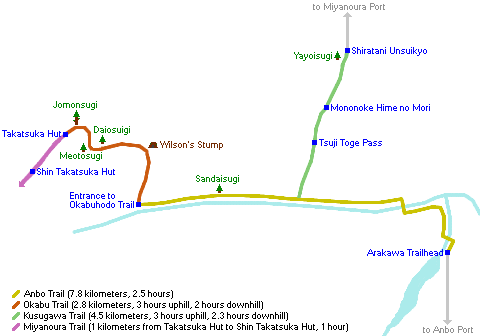
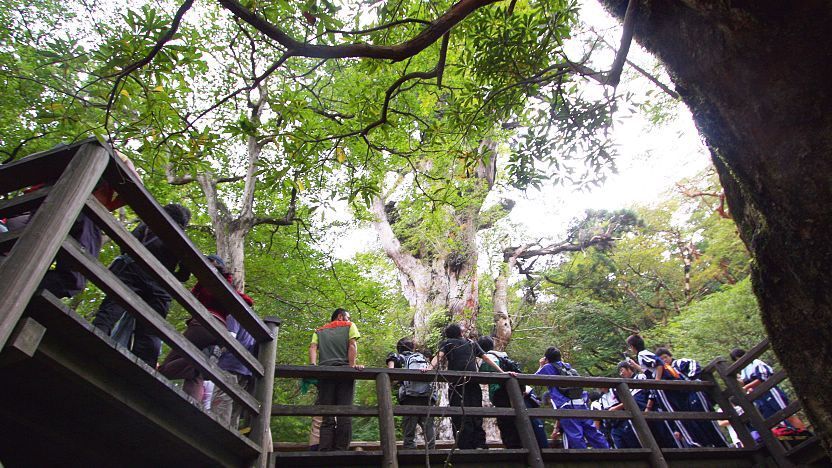
Along the trail to the Jomonsugi you can see some of Yakushima's other famous trees including the Meotosugi, a pair of trees that resemble a husband and wife embracing; the Daiosugi (lit. Great King Cedar) one of the largest trees on the island; and Wilson's Stump, the hollowed out remains of a giant cedar felled three centuries ago.

The hike takes about ten hours round trip, and you should leave before dawn in order to finish by sunset. The first part of the hike on the Anbo Trail runs along a seldom used railway that is flat and relatively easy. The second part on the Okabu Trail is a mixture of dirt footpaths, boardwalks and wooden steps, and is often steep.
If you prefer a more leisurely pace, you can stay overnight at Takatsuka Hut about 200 meters past the Jomonsugi. The larger Shin-Takatsuka hut is about one kilometer farther along the Miyanoura Trail. Neither hut is staffed. Overnight camping is permitted only at the huts and designated tent areas near the huts.

As with any hike, bringing the proper gear is essential. Good rain gear and hiking boots are highly recommended. You must bring your own food, toiletries, and plenty of water. Toilets and water are available at the trailhead, the entrance to Okabu Trail and by the Jomonsugi (toilets at Takatsuka Hut and water at the steps before the tree).
Japanese and English speaking guides are available, although they are not required as the trails are well marked in English and Japanese. The guides do, however, provide lots of information about the history and ecology of the sights along the way.

Getting there and around

The Jomonsugi can be reached only on foot, most commonly via the Anbo Trail. The trail begins at the Arakawa Trailhead which is about a 30 minute bus ride inland from Anbo Town. From March to November, private cars are not allowed to use the access road to the trailhead due to capacity limits. Instead, hikers will have to take a shuttle bus from the Yakusugi Museum (屋久杉自然館, Yakusugi Shizenkan) to the Arakawa Trailhead (荒川登山口, Arakawa Tozanguchi).
The shuttle bus ride takes 40 minutes and costs 1400 yen for a round trip, plus a 1000 yen fee for conservation efforts (2000 yen for those staying overnight in the mountain). Tickets should be purchased at least one day in advance at the tourist information desk at Miyanoura, Anbo or the airport, or through some of the island's hotels.
Shuttle buses depart the Yakusugi Museum for the trailhead in the early morning between 5:00 and 6:00 and in the opposite direction between 15:00 and 18:00. Access to the Yakusugi Museum is provided by regular buses and by many of the hotels on the island.
An alternative hiking route begins at Shiratani Unsuikyo, leads over the Tsuji Toge Pass, and meets up with the Anbo Trail about midway along its length. This route takes approximately 12 hours and is more difficult.
How to get to and around Yakushima Island

Questions? Ask in our forum.
Links and Resources