Sign in for a personalized experience.
Travel
Living
A-Z
Forum
Friends
Jobs
Shopping
Related Pages
Language

Language Schools

Calligraphy
Hiragana
Katakana
Studying Japanese
Japanese on computers
Names

Survey
How would you rate your experiences staying at Japanese hotels/ryokan?
Very good
Good
Neither good nor bad
Bad
Very bad
Never stayed at one
see results
Other Surveys:
Budget for ryokan stay
Next trip to Japan
Improvements to Tourism
Financial Crisis
Ski Destination
Preferred way to stay at a ryokan
Purpose of visit
Most popular region
Have you recently entered Japan?

japan-guide.com newsletter
Keeping you up to date on Japan travel and living related issues and site updates. Click here to subscribe!

Sponsored Listings
Car Rental
The cheapest rates in Japan!
Japan - Order FREE Brochure!
About vacation plans and specialty travel.
Tour Packages
Guided and individual tour plans.

Home - Language
Kanji

Kanji, one of the three scripts used in the Japanese language, are Chinese characters, which were first introduced to Japan in the 5th century via Korea.

Kanji are ideograms, i.e. each character has its own meaning and corresponds to a word. By combining characters, more words can be created. For example, the combination of "electricity" with "car" means "train". There are several ten thousands of characters, of which 2000 to 3000 are required to understand newspapers. A set of 1945 characters has been officially declared as the "kanji for everyday use".

Some examples:
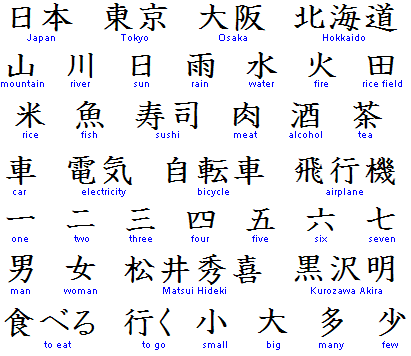
Before the introduction of Chinese characters, no Japanese writing system existed. When adopting the characters, the Japanese did not only introduce the characters' original Chinese pronunciations, but also associated them with the corresponding, native Japanese words and their pronunciations. Consequently, most kanji can still be pronounced in at least two ways, a Chinese (on yomi) and a Japanese (kun yomi) way, which considerably further complicates the study of the Japanese language.

Kanji are used for writing nouns, adjectives, adverbs and verbs. But unlike the Chinese language, Japanese cannot be written entirely in kanji. For grammatical endings and words without corresponding kanji, two additional, syllable based scripts are being used, hiragana and katakana, each consisting of 46 syllables.

Calligraphy is the art of writing beautifully.

English Links
The Kanji Site
Great web site for studying Kanji.
Jim Breen's WWWJDIC Server
Various useful language tools, including kanji lookup tools.

Product Links
The New Nelson Japanese-English Character Dictionary

Tuttle Kanji Cards

Essential Kanji
recommended by japan-guide.com: A very useful reference for all beginning and intermediate kanji students by Geoffrey O'Neill
The New Nelson Japanese-English Character Dictionary
recommended by japan-guide.com: A kanji dictionary for intermediate and advanced kanji students by John H. Haig and Andrew N. Nelson
Guide to Writing Kanji and Kana, Book 1
Book by Wolfgang Hadamitzky and Mark Spahn
Guide to Writing Kanji and Kana, Book 2
Book by Wolfgang Hadamitzky and Mark Spahn
Kanji Pict-O-Graphix: Over 1,000 Japanese Kanji and Kana Mnemonics
Book by Michael Rowley
Tuttle Kanji Cards
Tuttle Kanji Cards II
Flash Cards by Alexander Kask

Asian-inspired
living room furniture

Copyright © 1996-2009 japan-guide.com All rights reserved - Last Page Update: June 5, 2004
home - site map - privacy policy - terms of use - contact - L‚ɂ‚¢‚Ä - advertising