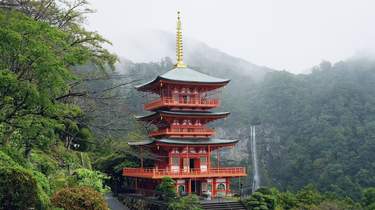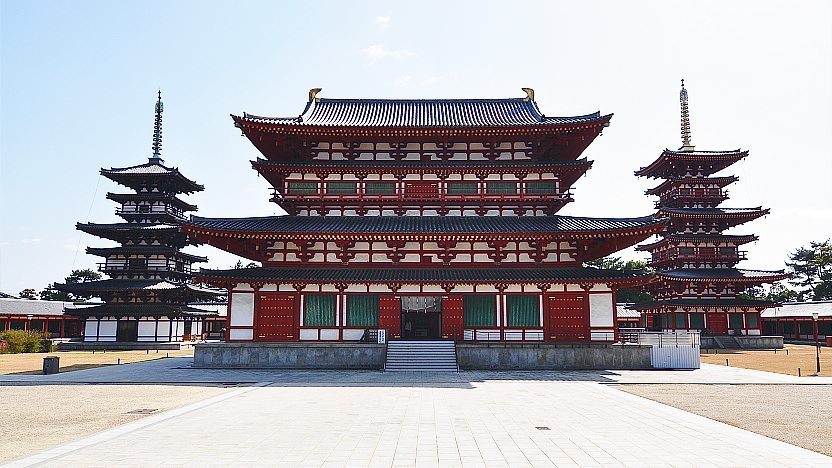
Yakushiji (–òŽtŽ›) was constructed by Emperor Tenmu in the late 7th century for the recovery of the emperor's sick wife. One of Japan's oldest temples, Yakushiji has a strictly symmetric layout, with the main hall and lecture hall standing on a central axis, flanked by two pagodas.
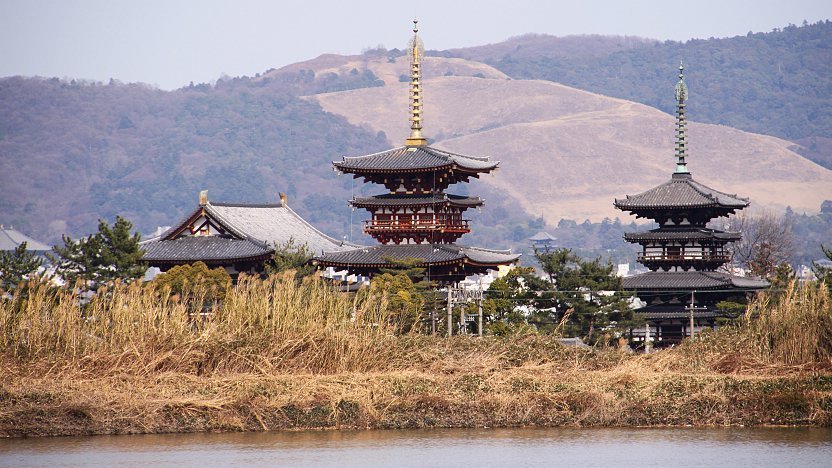
The main hall was rebuilt in the 1970s after being destroyed by fire and houses a Yakushi trinity, a masterpiece of Japanese Buddhist art. The East Pagoda is the temple's only structure to have survived the many fires that have beset the temple over the years, and dates from 730. It appears to have six stories, but is in fact only truly three-storied, like the West Pagoda.

The Genjo-sanzoin Garan is a relatively recently built complex located slightly north of the main complex area. Constructed in 1991, the complex is dedicated to the Chinese monk Genjo-sanzo, who lived in the 7th century and is famous for his extensive travels to India and Central Asia. Yakushiji is the head temple of the Hosso Sect of Japanese Buddhism, upon which Genjo-sanzo's teachings had a profound influence.
The main building at Genjo-sanzoin Garan is a central octagonal hall, in which some of Genjo-sanzo's remains are enshrined. Behind the octagonal hall is a building displaying works of Hirayama Ikuo, one of Japan's most celebrated painters who passed away in 2009. The paintings depict scenes of Genjo-sanzo's journeys, which have inspired Hirayama's work. Unfortunately, however, the complex is open to the public only during special opening periods.
Getting there and around
By train
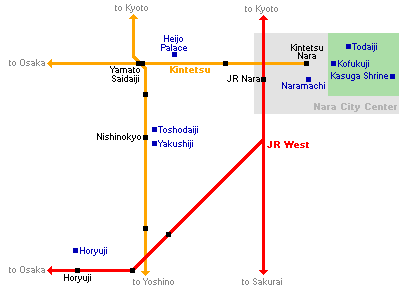
The temple is located right beside Nishinokyo Station, which can be reached from Kintetsu Nara Station by taking the Kintetsu Nara Line to Yamato-Saidaiji Station and transferring to the Kintetsu Kashihara Line. The entire trip takes about 25 minutes and costs 300 yen.
By bus
Bus number 72, 78 and 98 provide three connections per hour from Kintetsu Nara Station (20 minutes, 310 yen) and JR Nara Station (15 minutes, 310 yen) to Yakushiji Temple. The closest bus stop to get off are Yakushiji (–òŽtŽ›), served by buses 72 and 78, and Yakushiji Chushajo (–òŽtŽ›’“ŽÔ�ê), served by bus 98.
When returning to central Nara, you can catch bus number 72 or 77 from Nishinokyoeki bus stop (�¼ƒm‹ž‰w) twice per hour or bus number 97 from Yakushiji Chushajo bus stop hourly.

Hours and Fees
Hours
Closed
Admission
Questions? Ask in our forum.
Links and Resources
Japanese
Hotels around Nara

-
-
![]() Nara Kasugaokuyama TsukihiteiNara Kasugaokuyama Tsukihitei is located in the Kasugayama Primeval Forest, a UNESCO World Heritage site. Each guest room has a Japanese-style decor and offer panoramic forest views, traditional tatami (woven-straw) floors, and shoji paper screens. All guest rooms are equipped with Japanese-style futon beds. The rooms have an en suite bathroom. Kasuga Taisha Shrine is 400 metres away from the property. Todaiji Temple is about a 10-minute walk away. Kintetsu Nara Train Station and JR Nara Train Station are both less than a 10-minute drive away. Japanese-style breakfast and a set meal course dinners are prepared by the Japanese chef using seasonal specialities.View on Booking.com
Nara Kasugaokuyama TsukihiteiNara Kasugaokuyama Tsukihitei is located in the Kasugayama Primeval Forest, a UNESCO World Heritage site. Each guest room has a Japanese-style decor and offer panoramic forest views, traditional tatami (woven-straw) floors, and shoji paper screens. All guest rooms are equipped with Japanese-style futon beds. The rooms have an en suite bathroom. Kasuga Taisha Shrine is 400 metres away from the property. Todaiji Temple is about a 10-minute walk away. Kintetsu Nara Train Station and JR Nara Train Station are both less than a 10-minute drive away. Japanese-style breakfast and a set meal course dinners are prepared by the Japanese chef using seasonal specialities.View on Booking.com -
![]() Guest House OkuView on Booking.com
Guest House OkuView on Booking.comComfortable Accommodations
Guest House Oku in Nara offers family rooms with air-conditioning, tatami floors, and free WiFi. Each room includes a washing machine, slippers, and a shared bathroom.Convenient Facilities
The guest house provides bicycle parking, luggage storage, and a washing machine. Additional amenities include a washing machine and a shared bathroom.Prime Location
Located 1.8 km from Nara Station and 53 km from Itami Airport, the property is near attractions such as Iwafune Shrine (18 km) and Nippon Christ Kyodan Shijonawate Church (23 km).Guest Satisfaction
Highly rated by guests for its friendly host, convenient location, and comfortable beds. -
![]() SLOW HOUSE NARAView on Booking.com
SLOW HOUSE NARAView on Booking.comComfortable Accommodations
SLOW HOUSE NARA in Nara offers family rooms with air-conditioning, private bathrooms, bidets, and free WiFi. Each room includes a work desk, shower, and free toiletries.Convenient Facilities
Guests can enjoy a shared kitchen, bicycle parking, and an inner courtyard view. Additional amenities include a ground-floor unit with tatami floors and a quiet street setting.Prime Location
Located a 15-minute walk from Nara Station, the guest house is near attractions such as Iwafune Shrine (19 km) and Nippon Christ Kyodan Shijonawate Church (23 km). Itami Airport is 54 km away.Guest Satisfaction
Highly rated for its convenient location, attentive staff, and clean rooms. -
![]() Yuzan GuesthouseView on Booking.com
Yuzan GuesthouseView on Booking.comComfortable Accommodations
Yuzan Guesthouse in Nara offers a sun terrace, garden, and free WiFi. Guests enjoy air-conditioning, garden views, and parquet floors.Convenient Facilities
The hostel features a shared kitchen, private check-in and check-out, full-day security, bicycle parking, and luggage storage. Additional amenities include a hairdryer, shared bathroom, shower, and work desk.Prime Location
Nearby Attractions Nara Station is a 15-minute walk away. Nearby attractions include Iwafune Shrine (18 km) and Nara Park (6 km). Itami Airport is 53 km from the property.Guest Satisfaction
Highly rated for its convenient location, attentive staff, and well-equipped kitchen. -
![]() Hotel RokuneView on Booking.com
Hotel RokuneView on Booking.comComfortable Accommodations
Hotel Rokune in Nara offers comfortable rooms with air-conditioning, balconies, and private bathrooms. Guests enjoy amenities such as bathrobes, free WiFi, and soundproofing.Convenient Facilities
The hotel features a terrace, lift, laundry service, and free toiletries. Additional amenities include a work desk, TV, and soundproofing, ensuring a pleasant stay.Prime Location
Located 52 km from Itami Airport, Hotel Rokune is an 8-minute walk from Nara Station. Nearby attractions include Iwafune Shrine (18 km) and Nippon Christ Kyodan Shijonawate Church (22 km).Guest Satisfaction
Highly rated for room comfort, convenient location, and room cleanliness, Hotel Rokune provides excellent service and a pleasant environment. -
![]() Mountain Home Lodge in Deer ParkView on Booking.com
Mountain Home Lodge in Deer ParkView on Booking.comComfortable Accommodations
Mountain Home Lodge in Deer Park offers family rooms with air-conditioning, private bathrooms, and fully equipped kitchens. Each room includes a washing machine, dining area, and free WiFi.Convenient Facilities
Guests benefit from daily housekeeping, luggage storage, and a dining table. Additional amenities include a sofa bed, wardrobe, and free toiletries.Local Attractions
Located 3.3 km from Nara Station and 20 km from Iwafune Shrine, the lodge provides easy access to nearby attractions. Itami Airport is 55 km away.Guest Favorites
Visitors appreciate the convenient location for nature trips, fully equipped kitchen, and excellent service. -
![]() Hilo HostelView on Booking.com
Hilo HostelView on Booking.comComfortable Accommodations
Hilo Hostel in Nara offers air-conditioned rooms with tatami floors, work desks, and sofas. Each room includes a bidet, shower, and slippers.Essential Facilities
Guests enjoy free WiFi, a lounge, shared kitchen, full-day security, and luggage storage. Additional amenities include a hairdryer and shared bathrooms.Convenient Location
Located less than 1 km from Nara Station, the hostel is 53 km from Itami Airport. Nearby attractions include Iwafune Shrine (18 km) and Nippon Christ Kyodan Shijonawate Church (22 km).Guest Satisfaction
Highly rated for its friendly host, excellent public transport options, and convenient location. -
![]() Hotel New WakasaA 12-minute walk from the Kintetsu Nara Train Station, Hotel New Wakasa offers Japanese-style rooms with tatami (woven-straw) flooring. A spacious public bath and foot bath is available for guests to relax in. Free luggage before and after check-in is available on site. Free WiFi is available at the entire building. The air-conditioned rooms feature Japanese futon bedding and a separate seating area. Each provides a flat-screen TV, a refrigerator, and an electric kettle with green tea bags. The en suite bathroom includes a hairdryer. Guests can go to the roof terrace for a beautiful view of the Mount Wakakusa and the Todaiji Temple. A private spa pool with the same view can be requested with an extra cost. A Japanese dinner and breakfast are served in the dining room. New Wakasa Hotel is an 5-minute walk from the Todaiji Temple, and a 15-minute walk from the Nara Park. It is also an 8-minute walk from Isuien and an 80-minute bus ride from Kansai Airport. The property provides free guided tours in English to guests as a service. English maps and information are available on site as well.View on Booking.com
Hotel New WakasaA 12-minute walk from the Kintetsu Nara Train Station, Hotel New Wakasa offers Japanese-style rooms with tatami (woven-straw) flooring. A spacious public bath and foot bath is available for guests to relax in. Free luggage before and after check-in is available on site. Free WiFi is available at the entire building. The air-conditioned rooms feature Japanese futon bedding and a separate seating area. Each provides a flat-screen TV, a refrigerator, and an electric kettle with green tea bags. The en suite bathroom includes a hairdryer. Guests can go to the roof terrace for a beautiful view of the Mount Wakakusa and the Todaiji Temple. A private spa pool with the same view can be requested with an extra cost. A Japanese dinner and breakfast are served in the dining room. New Wakasa Hotel is an 5-minute walk from the Todaiji Temple, and a 15-minute walk from the Nara Park. It is also an 8-minute walk from Isuien and an 80-minute bus ride from Kansai Airport. The property provides free guided tours in English to guests as a service. English maps and information are available on site as well.View on Booking.com -
![]() Ryokan Asukasou at the entrancne of Nara parkView on Booking.com
Ryokan Asukasou at the entrancne of Nara parkView on Booking.comComfortable Accommodations
Ryokan Asukasou in Nara offers family rooms with private bathrooms, air-conditioning, and modern amenities. Each room includes a kitchenette, balcony, and free WiFi.Relaxing Facilities
Guests can unwind on the terrace or enjoy the open-air bath. Additional amenities include a lounge, public bath, and free on-site private parking.Delicious Breakfast
A daily Asian breakfast featuring local specialities is served, highly praised by guests for its quality and variety.Prime Location
Located 1.8 km from Nara Station, the ryokan is near attractions such as Iwafune Shrine (20 km) and Itami Airport (54 km). Guests appreciate the friendly staff and convenient location. -
![]() Wakasa AnnexWakasa Annex features an outdoor hot public bath and free WiFi. Other facilities include a 24-hour reception, drinks vending machines and free parking. Todai-ji Temple is only an 8-minute walk. Soundproof rooms feature a serene interior with a tatami (woven-straw) floor, low furniture and shoji paper screens. Amenities include a flat-screen TV with satellite channels, a fridge and toiletries. Guests sleep in Japanese futon bedding, and the rooms come with an all-wooden bathroom. Luggage storage is offered before and after check-in/check-out. English maps for exploring the area are available, and the property staff organises free tours guided in English for staying guests. Annex Wakasa serves Japanese cuisine for breakfast and dinner at the dining area. Dinner is a traditional kaiseki multi-course meal featuring seasonal dishes. The hotel is an 8-minute walk from Japanese garden Isui-en, and a 15-minute walk from Nara Park. Nara Train Station is a 12-minute walk, while Kansai Airport is 80 minutes by bus.View on Booking.com
Wakasa AnnexWakasa Annex features an outdoor hot public bath and free WiFi. Other facilities include a 24-hour reception, drinks vending machines and free parking. Todai-ji Temple is only an 8-minute walk. Soundproof rooms feature a serene interior with a tatami (woven-straw) floor, low furniture and shoji paper screens. Amenities include a flat-screen TV with satellite channels, a fridge and toiletries. Guests sleep in Japanese futon bedding, and the rooms come with an all-wooden bathroom. Luggage storage is offered before and after check-in/check-out. English maps for exploring the area are available, and the property staff organises free tours guided in English for staying guests. Annex Wakasa serves Japanese cuisine for breakfast and dinner at the dining area. Dinner is a traditional kaiseki multi-course meal featuring seasonal dishes. The hotel is an 8-minute walk from Japanese garden Isui-en, and a 15-minute walk from Nara Park. Nara Train Station is a 12-minute walk, while Kansai Airport is 80 minutes by bus.View on Booking.com
-