Trains
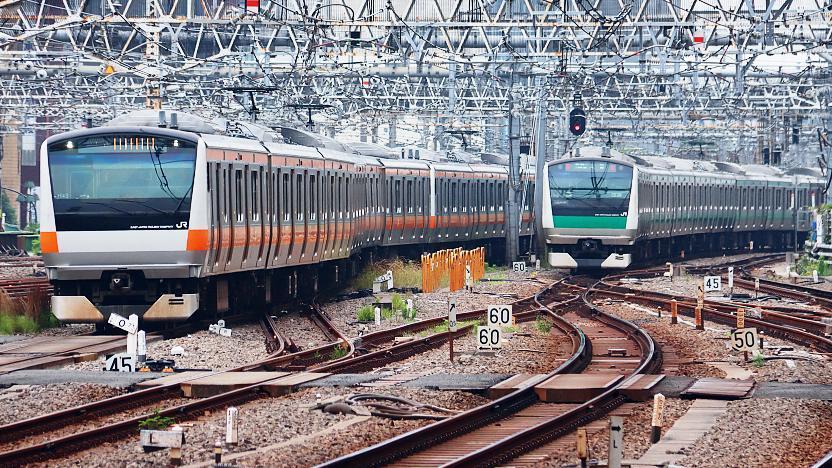
Japan's four major islands - Honshu, Hokkaido, Kyushu and Shikoku - are covered by an extensive and reliable network of railways. Trains are a very convenient way for visitors to travel around Japan, and a wide array of rail passes is available.
About 70 percent of Japan's railway network is operated by the Japan Railways (JR), while the rest is served by dozens of other private railway companies, especially in and around metropolitan areas.
Elsewhere on the site are pages on how to ride trains, shinkansen, limited express trains, tickets and timetables, and a rail pass calculator to see whether a rail pass pays off.
Japan Railways (JR)
The Japan Railways Group (JR Group) is the successor of the Japanese National Railways (JNR), which were privatized in 1987. The JR Group is made up of six regional passenger railway companies, which are JR Hokkaido, JR East, JR Central, JR West, JR Shikoku and JR Kyushu, and one nationwide freight railway company, JR Freight. Together they operate a nationwide network of urban, regional and interregional train lines and the shinkansen (bullet trains).

Private railway companies
Dozens of private railway companies exist in Japan. The smaller ones operate just a single line, while others operate extensive networks. Below are the major private railway companies:
Greater Tokyo
- Tobu (approx. 460 km)
https://www.tobu.co.jp/
Tobu operates an extensive network of railway lines into the suburbs and prefectures north of Tokyo. Of interest to tourists: access to Nikko and Kawagoe. - Odakyu (approx. 120 km)
https://www.odakyu.jp/
Odakyu operates three lines from central Tokyo to western Tokyo and Kanagawa Prefecture. Of interest to tourists: access to Hakone and Enoshima. - Tokyu (approx. 100 km)
https://www.tokyu.co.jp/
Tokyu operates a network of two main lines and several shorter lines in the south of Tokyo. Of interest to tourists: access to Yokohama. - Keisei (approx. 100 km)
https://www.keisei.co.jp/
Keisei operates a main line and several branch lines from Tokyo to Chiba Prefecture. Of interest to tourists: access to Narita Airport. - Seibu (approx. 180 km)
https://www.seiburailway.jp/
Seibu operates a network of suburban railway lines west of central Tokyo. Of interest to tourists: access to Chichibu and Kawagoe. - Keikyu (approx. 90 km)
https://www.keikyu.co.jp/
Keikyu connects Tokyo with Yokohama and southern Kanagawa Prefecture. Of interest to tourists: access to Haneda Airport and Yokohama. - Keio (approx. 80 km)
https://www.keio.co.jp/
Keio operates a network of railway lines west of central Tokyo. Of interest to tourists: access to Mount Takaosan.
Greater Nagoya
- Meitetsu (approx. 450 km)
https://www.meitetsu.co.jp/
Meitetsu operates an extensive railway network around Nagoya. Of interest to tourists: access to Inuyama and Central Japan Airport.
Greater Osaka
- Kintetsu (approx. 500 km)
https://www.kintetsu.co.jp/
Kintetsu operates the largest network among non-JR companies, connecting Osaka, Kyoto, Nara, Ise and Nagoya. - Nankai (approx. 170 km)
http://www.nankai.co.jp/
Nankai operates a network of railway lines in southern Osaka and Wakayama Prefecture. Of interest to tourists: access to Kansai Airport and Koyasan. - Hankyu (approx. 150 km)
https://www.hankyu.co.jp/
Hankyu operates several lines in northern Osaka and connects Osaka with Kobe and Kyoto. - Keihan (approx. 90 km)
https://www.keihan.co.jp/
Keihan operates one main line, connecting Osaka with Kyoto and several shorter lines. - Hanshin (approx. 50 km)
https://www.hanshin.co.jp/
Hanshin operates one main line between Osaka and Kobe, and a few short branch lines.
Greater Fukuoka
- Nishitetsu (approx. 120 km)
http://www.nishitetsu.jp/
Nishitetsu operates a network of railway lines in Fukuoka Prefecture around the city of Fukuoka. Of interest to tourists: access to Dazaifu.
Questions? Ask in our forum.