IC Cards

Suica, Pasmo, Icoca and seven more of Japan's most popular IC cards were made compatible with each other in 2013, making it possible to travel on almost all trains, subways and buses in most of Japan's largest cities with just a single of these cards.
What is an IC card?
IC cards are rechargeable cards that can be used to conveniently pay fares on public transportation and to make payments at many vending machines, shops and restaurants by simply touching the card on a reader for about one second. Dozens of train and bus operators across Japan have started issuing their own IC cards since 2001.
Instead of physical IC cards, it is possible to use digital versions of some of the cards on mobile phones; however, at present, oversea tourists can do this only if they own an Iphone.
Validity
What are the ten major IC cards?
The following ten major IC cards are compatible with each other:









What is covered and what is not?
The ten cards are valid on virtually all trains, subways and buses in most of Japan's major cities, including Tokyo, Osaka, Kyoto, Nagoya and Fukuoka. But there are a few issues to keep in mind:
- Travel outside or between IC card areas
It is not possible to travel outside IC card areas. Both, the origin and destination stations have to be located inside the IC card's coverage area. Furthermore, it is not possible to use an IC card to travel between disjoined IC card areas (except when using shinkansen trains; see details below). For example, you cannot use it to travel between Tokyo and Sendai.
- Shinkansen
IC cards can be used on selected shinkansen lines, but need some set-up before use. There are currently three different systems:
- On the Tokaido/Sanyo/Kyushu Shinkansen
IC cards can be used on the Tokaido/Sanyo/Kyushu Shinkansen via smartEX. In order to do so, one or more IC cards and a credit card have to be registered on the website. Afterwards, it is possible to purchase shinkansen tickets online and use the registered IC cards to pass through the shinkansen ticket gates. Fares are charged to the registered credit card rather than subtracted from the IC cards' balance. More details. - On shinkansen in eastern and northern Japan
It is possible to use regular IC cards on all shinkansen trains in eastern and northern Japan by purchasing e-tickets through EkiNet. Fares are charged to the registered credit card rather than subtracted from the IC cards' balance. More details. - On shinkansen operated by JR East
Regular IC cards can be used on non-reserved seats along the Tohoku, Akita, Yamagata, Joetsu and Hokuriku Shinkansen trains (Hokuriku Shinkansen only between Tokyo and Joetsu-Myoko stations). Before you can use an IC card for this service, which is known as "Touch de Go", a one-time set-up procedure is required at a ticket machine. Fares will be subtracted from the IC card's balance.
- On the Tokaido/Sanyo/Kyushu Shinkansen
- Other trains requiring a supplement fee
When riding other trains that require a supplement fee, e.g. limited express trains, travelers can use the IC card to pay the base fare when passing through the ticket gates, but the supplement ticket needs to be purchased separately at a ticket machine, office or online.
- Highway buses
Many highway buses cannot be paid by IC card.
The table below shows in more detail the coverage of the IC cards:
Sendai Tokyo Yokohama Kamakura Fuji Five Lakes Hakone Nikko Nagoya Kyoto Osaka Nara Kobe Himeji Mount Koya Okayama Hiroshima Fukuoka Beppu |
|
|
|
|
| |
|
(covered from spring 2027) |
| |
|
|
| |
|
|
| |
|
|
Basic use
How to use IC cards?
When passing automatic ticket gates, touch the card onto the card reader for about one second (rather than inserting it into the ticket slot). The applicable fare will be automatically deducted when you exit through the ticket gate at your destination station. When riding buses, card readers are placed at the entrance and/or exit of the bus. A card cannot be shared by multiple travelers for the same ride. Each traveler needs a separate card.

Is there a discount over regular tickets?
IC cards generally do not provide any discounts over regular tickets. But in Greater Tokyo, Niigata and Sendai, train fares can differ by a few yen depending on whether an IC card or a paper ticket is used. This is because fares are rounded to the nearest ten yen in case of paper tickets, but not rounded in case of IC cards. Around central Tokyo, payment by IC card is always cheaper than payment by paper ticket (by up to nine yen), but outside of central Tokyo, either ticket type can be up to five yen cheaper than the other.
Where to get an IC card?
IC cards can be purchased at ticket machines and ticket counters of the issuing railway companies. The initial cost consists of a refundable deposit of 500 yen plus an initial amount (typically 1500 yen) to be charged onto the card. For a surcharge, Suica and Pasmo cards can also be purchased and sent to you before the start of your trip through Japan Experience. Last but not least, Iphone users can add Suica, Pasmo and Icoca cards to Apple Pay.
Are there digital versions of the IC cards?
Iphone 8 and later models can be set up to serve as Suica, Pasmo and Icoca cards by adding the cards to Apple Pay, but note that some credit cards issued outside of Japan cannot be used to charge your card. In addition, the "Welcome Suica Mobile" app is available for Iphones.
Android phones can be used as IC cards through the "Mobile Suica", "Mobile Pasmo", "Mobile Icoca" and "Mobile Toica" apps; however, the apps are targeted at residents of Japan and difficult or impossible to use for visitors to Japan. Specifically, they require Osaifu Keitai compatibility, which is not provided by most phones sold outside of Japan, come in Japanese only, and require an address in Japan and possibly a credit card that has been issued in Japan.
However, it was announced recently that Samsung plans to make its newest phone models compatible with Suica cards worldwide, starting sometime in the first half of 2027.
Which IC card shall I get?
The IC cards are virtually identical to each other in terms of coverage. The cards differ mainly on where they can be purchased and refunded. Therefore, most people will want to purchase the card available in the first city they visit, e.g. Suica or Pasmo in Tokyo or Icoca in Osaka. If you load a digital card onto your mobile phone, then you have the choice of Suica, Pasmo or Icoca regardless of your geographical location.
Shall I get a regular Suica or Welcome Suica?
The main advantage of Welcome Suica over regular Suica cards (and Tourist Pasmo over regular Pasmo) is that the 500 yen refundable deposit fee does not need to be paid. So, if you stay in Japan for less than four weeks*, won't return anytime soon, and want to skip the refund process at the end of your stay, then Welcome Suica can make sense to you. However, if you stay in Japan longer than four weeks, will be returning to Japan within ten years, and would rather not have your balance expire after four weeks*, the regular Suica card will be the better option. Regular Suica cards are also more widely sold than Welcome Suica cards, which are available only at limited locations.
* 180 days in case you use the Iphone app
How to recharge IC cards?
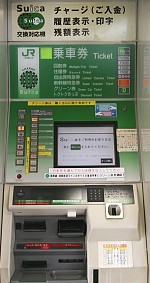
IC cards can be recharged at ticket machines and special re-charging machines found in strategically meaningful locations. They can also be recharged at stations of companies other than the issuing company, e.g. Suica can also be recharged in Osaka. Furthermore, many convenience stores allow IC cards to be recharged at the cashier. The maximum amount to be charged onto a card is 20,000 yen.
How to check the current balance?
The current credit balance is shown on a small display whenever you pass a ticket gate or make a payment at a store. Furthermore, the balance can be checked at ticket machines together with a usage history.
How to get back the 500 yen refundable deposit?
Bring your card to the ticket counter of the issuing operator in order to get back your 500 yen deposit. Unused credit can also be refunded; however, most companies will subtract a 220 yen handling fee from the remaining balance. Note that IC cards can be returned only to the issuing company, e.g. it is not possible to return a Suica card in Osaka or an Icoca card in Tokyo.
Is there an expiry date?
Regular IC cards become invalid if they are not used for ten years. In contrast, tourist-targeted Welcome Suica cards have a much shorter lifetime: physical cards expire after 28 days, while digital versions expire after 180 days.
Card types
Besides regular cards, there are personalized cards which can be replaced if lost (handling fee applies), commuter cards which also serve as a commuter pass, and cards for children.
How to use smartEX and EkiNet to ride the shinkansen with an IC card?
Please view the video below for more details on how you can ride shinkansen trains with an IC card instead of physical tickets through the use of smartEX (in western Japan) and EkiNet (in eastern and northern Japan):
Questions? Ask in our forum.