Shinkansen
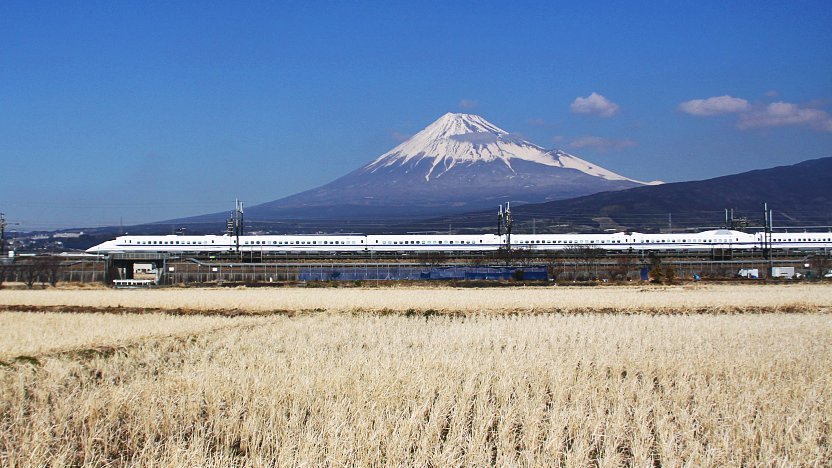
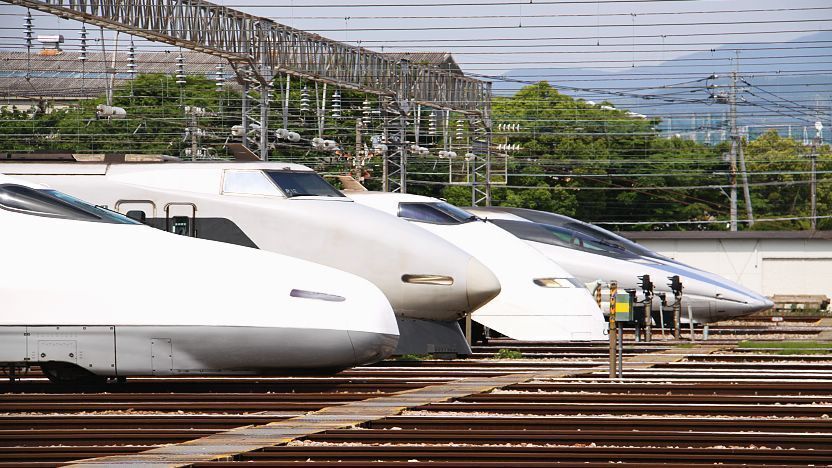
Japan's main islands of Honshu, Kyushu and Hokkaido are served by a network of high speed train lines that connect Tokyo with most of the country's major cities. Japan's high speed trains (bullet trains) are called shinkansen (新幹線) and are operated by Japan Railways (JR).
Running at speeds of up to 320 km/h, the shinkansen is known for punctuality (most trains depart on time to the second), comfort (relatively silent cars with spacious, always forward-facing seats), safety (no fatal accidents in its history) and efficiency. Thanks to various rail passes, the shinkansen can also be a cost-effective means of travel.
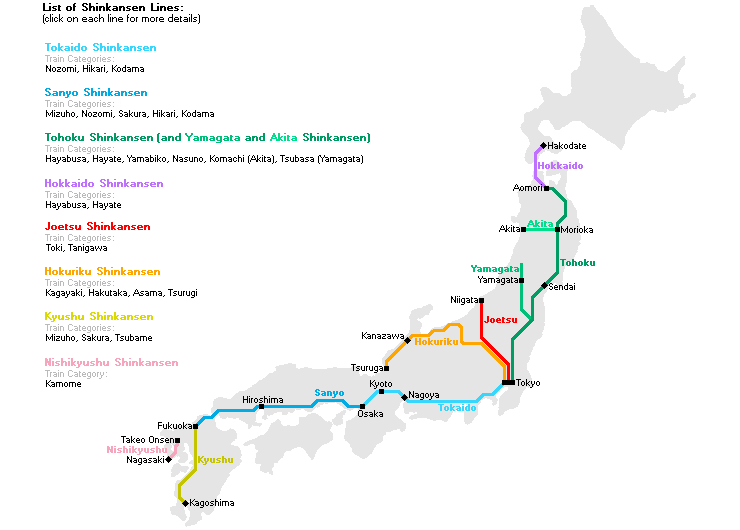
Shinkansen network
The shinkansen network consists of multiple lines, among which the Tokaido Shinkansen (Tokyo - Nagoya - Kyoto - Osaka) is the oldest and most popular. All shinkansen lines (except the Akita and Yamagata Shinkansen) run on tracks that are exclusively built for and used by shinkansen trains. Most lines are served by multiple train categories, ranging from the fastest category that stops only at major stations to the slowest category that stops at every station.
Seats and classes
Seat classes
Trains offer seats in two or three classes, which are typically found in separate cars:


Reserved vs. non-reserved cars
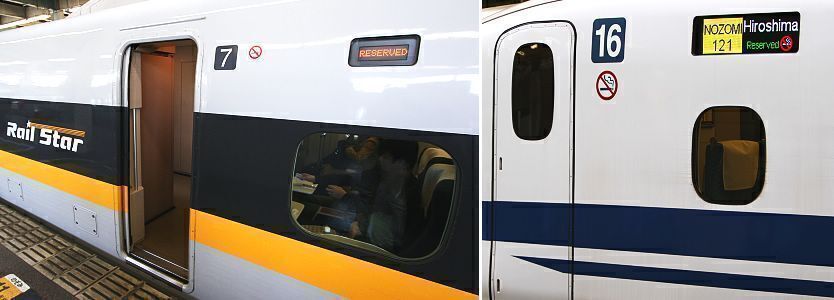
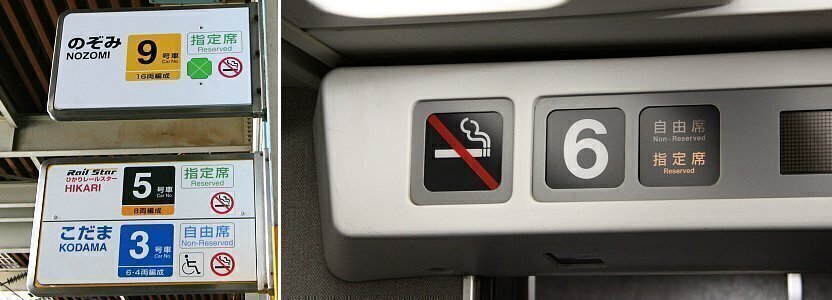
Most shinkansen trains offer both non-reserved seats (自由席, jiyūseki) and reserved seats (指定席, shiteiseki) in separate cars. Only the Hayabusa, Hayate, Komachi and Tsubasa trains on the Tohoku Shinkansen and Hokkaido Shinkansen and the Kagayaki trains on the Hokuriku Shinkansen are fully reserved and do not carry non-reserved seating. In addition, Nozomi trains along the Tokaido/Sanyo Shinkansen become temporarily fully reserved during long weekends, the New Year, Golden Week and Obon holidays. All seats in Green Cars are reserved. Bilingual signs indicate whether a car carries reserved or non-reserved seats.
Advance seat reservations are required to use a seat in a reserved car (see below on how to make seat reservations). A fee of a few hundred yen applies for making seat reservations. Japan Rail Pass holders can make seat reservations for free.
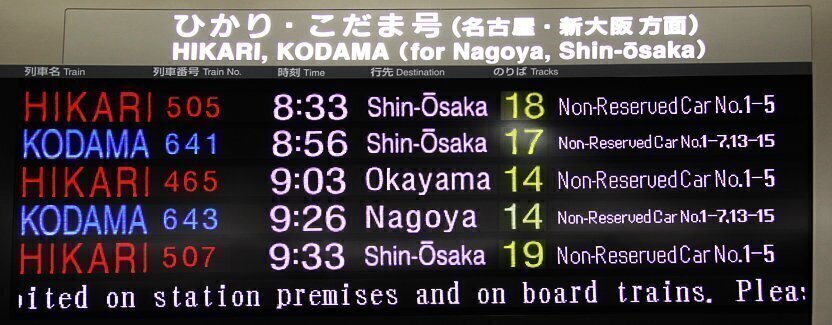
Seat reservations
Seat reservations allow you to secure a seat and travel with peace of mind. They can be made for all shinkansen trains, but are not mandatory on the trains that also carry non-reserved seating. Only the Hayabusa, Hayate, Komachi and Tsubasa trains along the Tohoku/Hokkaido Shinkansen, and the Kagayaki trains along the Hokuriku Shinkansen require seat reservations. In addition, Nozomi trains along the Tokaido/Sanyo Shinkansen become temporarily fully reserved during the New Year, Golden Week and Obon holidays.
Seat reservations can be made from one month before travel date (from 10:00am) until shortly before departure time. They can be made at ticket offices, at ticket machines or online. (Through the Tokaido Sanyo Kyushu Shinkansen Online Reservation Service reservations can be made up to one year in advance).
Are seat reservations recommended?
On many trains reserved seats do not get booked out, but on some they do. On particularly busy travel days (e.g. peak travel days during Golden Week, Obon and the New Year holidays), trains can get booked out several days in advance, but on most other days trains rarely get booked out more than a few hours in advance, if at all.
For peace of mind seat reservations are always recommended, especially when traveling in groups and preferring to sit together. On a few shinkansen trains along the Tohoku Shinkansen, Hokkaido Shinkansen and Hokuriku Shinkansen seat reservations are mandatory.
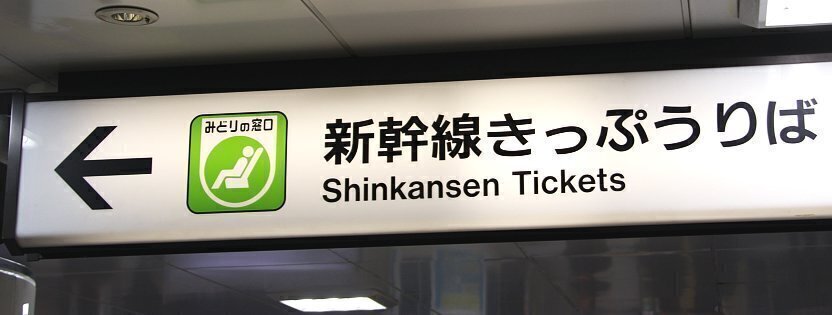
Shinkansen tickets
Regular paper tickets for the shinkansen can be purchased at ticket counters, at ticket machines or online. Alternatively, IC cards can be used. Last but not least, there are several rail passes and other types of discount tickets that can be used on the shinkansen.
Fees that make up a shinkansen ticket
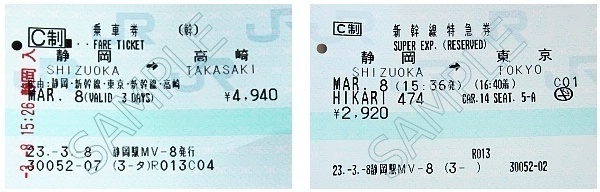
A shinkansen ticket is made up of the following fees:
- Base fare
The fare to get from A to B. Increases stepwise according to the distance traveled. Issued as a base fare ticket (乗車券, jōshaken). - Shinkansen supplement (aka limited express fee)
The supplement fee for using a shinkansen train (as opposed to a local train). The fee increases stepwise according to the distance traveled. The express supplement is issued as a limited express fee ticket (特急券, tokkyūken). - Seat reservation fee
330, 530, 730 or 930 yen depending on the date of travel. An additional supplement (100-1060 yen depending on distance traveled) applies for using reserved seats on Nozomi, Mizuho, Hayabusa and Komachi trains. The seat reservation fee is included into the above-mentioned express supplement. - Green car fee (if using a green car)
The supplement fee for riding the green car. Increases stepwise according to the distance traveled. It is combined with the express supplement into a single ticket.
Shinkansen passengers typically receive two pieces of tickets: a base fare ticket and a supplement ticket. In some situations the two tickets are combined into a single ticket, while more than two tickets may be issued if multiple trains are involved (one base fare ticket and one supplement ticket for each train).
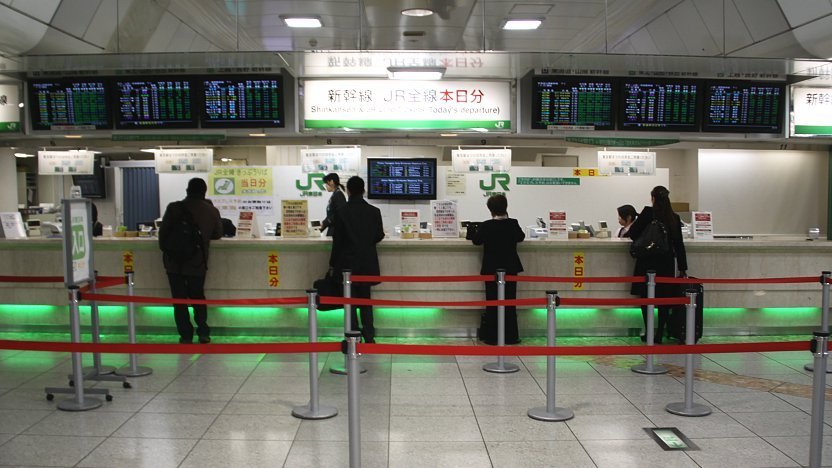
Buying a ticket at the ticket counter
Shinkansen tickets can be purchased at any ticket office found at all major and many minor JR stations nationwide. Credit cards are accepted at most ticket offices. In order to purchase a ticket, the following information is needed:
- Number of travelers
- Date of travel
- Departure station
- Destination station
- Ordinary or green car
- Reserved or non-reserved seat
For a seat reservation, the following additional information is required:
- Train name (e.g. Hikari) and train number or departure time
If you do not speak Japanese, it is recommended that you write the data on a piece of paper and present it to the salesperson in order to make the purchasing process smoother. Salespersons are generally familiar with the English vocabulary needed for the purchase of train tickets and seat reservations, but many have limited English conversation skills.
Buying a ticket at a ticket machine
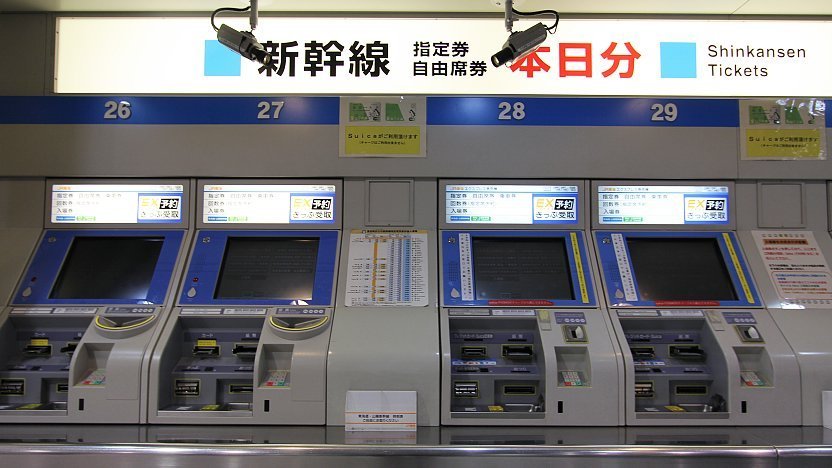
Selected ticket machines can be used to buy shinkansen tickets. Most of them offer English menus. Some machines sell only non-reserved seats, while others can be used to also make seat reservations. Although ticket machines can be very useful if you know how to use them, the process of buying shinkansen tickets is not always straight-forward.
Buying a ticket online
Although such websites exist in Japanese, there is currently no single English website for buying tickets for shinkansen nationwide. Instead, there are multiple systems that each cover only selected lines. Two of them allow for the use of IC cards in place of paper tickets. If using paper tickets, you will need to pick up the tickets in the region covered by each system from a ticket machine or ticket office before boarding the train.

- Tokaido Sanyo Kyushu Shinkansen Online Reservation Service (smart EX)
The Tokaido Sanyo Kyushu Shinkansen Online Reservation Service by JR Central covers the Tokaido, Sanyo and Kyushu shinkansen. Users can then use the shinkansen with a) IC cards registered with the system, b) QR code tickets provided by the system, or c) physical tickets picked up from a ticket machine, but note that tickets can be picked up only at stations along the Tokaido/Sanyo/Kyushu Shinkansen and in central Japan. In a limited number of countries, this service is also available as a smartphone app, called smart EX. - JR East Reservation System (EkiNet)
JR East's reservation website covers the Tohoku, Akita, Yamagata, Hokkaido, Joetsu and Hokuriku shinkansen, as well as selected limited express trains in eastern Japan, but note that it cannot be used to buy tickets for journeys that involve a transfer. The system can be used also by holders of regional rail passes by JR East for making seat reservations. Tickets need to be picked up in eastern Japan. Alternatively, IC cards can be used instead of paper tickets on shinkansen trains. - JR West Reservation System
JR West's reservation website covers the Tokaido, Sanyo, Kyushu, Hokuriku and Joetsu shinkansen, as well as the Tohoku Shinkansen as far as Nasu-Shiobara and limited express trains in western Japan. It can be used also by holders of selected regional rail passes to make seat reservations. Tickets need to be picked up in western Japan (including Kyushu). - JR Kyushu Reservation System
JR Kyushu's reservation website covers the Kyushu, Nishikyushu, Sanyo and Tokaido shinkansen, as well as limited express trains in western Japan. A separate website allows Kyushu Rail Pass holders to make seat reservations. Tickets need to be picked up in Kyushu.
In addition to the above-mentioned JR-operated websites, there are an increasing number of third-party online ticket services available on the internet, such as Japan Experience. These websites allow tickets to be purchased online and to be picked up or delivered to an address in Japan for a service fee of typically 10-20%.
IC cards
IC cards, such as Suica or Icoca, can be used on selected shinkansen lines and need some set-up before use. There are currently three different systems:

- Tokaido Sanyo Kyushu Shinkansen Online Reservation Service (smart EX)
The above-mentioned Tokaido Sanyo Kyushu Shinkansen Online Reservation Service allows users to register IC cards with the system and then use an IC card to ride the Tokaido/Sanyo/Kyushu Shinkansen. Fares are charged to a registered credit card rather than subtracted from the IC card's balance. - JR East Reservation System (EkiNet) - for shinkansen trains in eastern Japan
In combination with the above-mentioned JR East Reservation System, it is possible to use IC cards to ride shinkansen trains in eastern and northern Japan. Fares are charged to a registered credit card rather than subtracted from the IC card's balance. - Touch de Go - for shinkansen trains in eastern Japan
Regular IC cards, including Suica, Pasmo and Icoca, can be used on non-reserved seats of shinkansen trains in the entire service area of JR East (see map above). Before you can use an IC card for this service, which is known as "Touch de Go", a one-time set-up procedure is required at a ticket machine. Fares will be subtracted from the IC card's balance.
Rail passes
The Japan Rail Pass can be used on all shinkansen trains and covers all the fees involved (except for a supplement fee required for Nozomi and Mizuho trains). Seat reservations can be made for free at ticket machines and ticket offices. Pass holders will receive a seat reservation ticket that indicates the reserved seat. They need no tickets besides their rail pass when using non-reserved seats. Numerous regional passes also cover some shinkansen trains.
Other discount tickets
Small discounts are available for set ticket (回数券, kaisūken) and round trip tickets (往復割引, ōfukuwaribiki) that are available for selected sections. Other tickets provide a discount when purchased in advance (早得, hayatoku). Discount ticket shops around major stations also sell shinkansen tickets at small discounts.
More substantial savings are provided by travel packages which have to be purchased in advance at travel agencies. Among them are the "Shinkansen Travel Packages" and "Shinkansen One-Way Trip" (also known as Platt-Kodama) for travel along the Tokaido Shinkansen (including Tokyo-Kyoto and Tokyo-Osaka), sold at JR Tokai Tours travel agencies.
JR West also offers discounted one-way tickets along the Sanyo Shinkansen and Hokuriku Shinkansen exclusively to overseas tourists. Prospective travelers will first receive a mobile voucher which can then be exchanged to the real ticket at a ticket machine.
How to use the shinkansen?
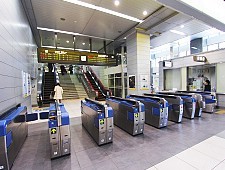
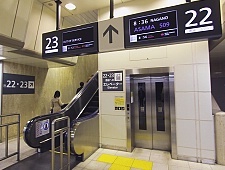
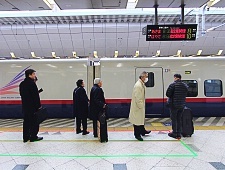
After purchasing your ticket (see above), proceed as follows:
Your seat
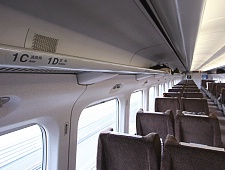
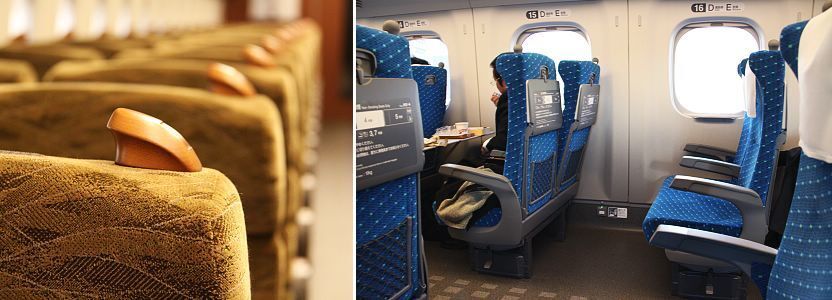
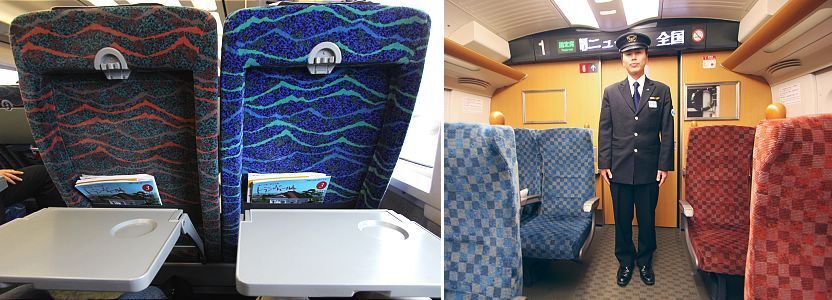
Ordinary seats typically come in rows of 3+2 seats, although on some trains they are arranged in rows of 2+2 seats. Seats can be reclined and have tables, pockets for magazines and open overhead shelves. They provide considerably more foot space than economy seats on airplanes. Newer train sets have electrical outlets installed along the walls or in the armrest.
Green cars always come with rows of 2+2 seats and have seats that are more spacious than ordinary seats. The seats are often equipped with a foot rest, reading light, electrical outlets and a seat warmer, although the exact facilities depend on the train set.
All seats on shinkansen trains can be turned by 180 degrees, allowing travelers to always face forward. The seats are turned by the staff at the terminal stations, but can also be turned by passengers, for example, to create a group of four or six seats facing each other.
Amenities & services
Signs and announcements inside the trains are multilingual (Japanese and English on all lines; plus Korean and Chinese on selected lines) and inform about upcoming stations.
A gradually decreasing number of shinkansen trains are served by small food carts with a selection of snacks, drinks and boxed meals (bento) which periodically pass along the aisle.
Free Wi-Fi is available on board of most shinkansen trains and at many shinkansen train stations. Depending on the operating company, the networks are known as Shinkansen Free Wi-Fi, JR-EAST FREE Wi-Fi and JR-WEST FREE Wi-Fi.
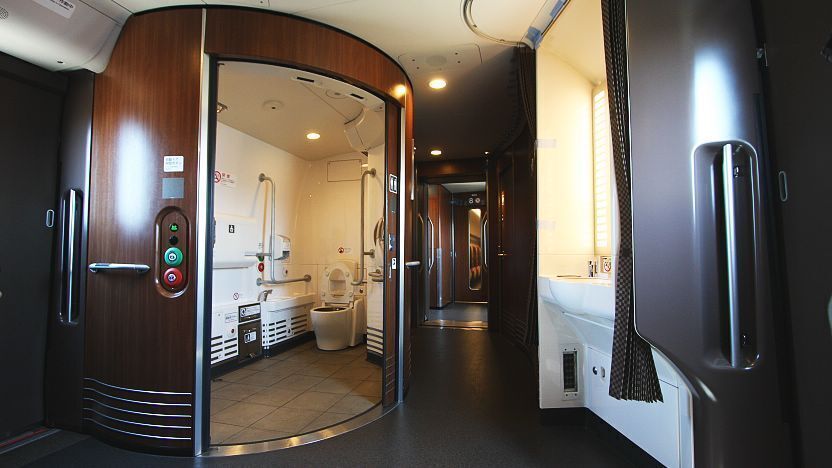
All shinkansen are equipped with multiple toilets, which are sometimes separated by gender. The toilets are Western-style except on some older train sets. Newer train sets are also equipped with spacious toilets for wheelchair users. Outside the toilets are wash corners with sinks and large mirrors.
Smoking
Smoking is not allowed on board of any shinkansen trains. Smoking in stations and on platforms is also prohibited, except in designated smoking zones.
Luggage
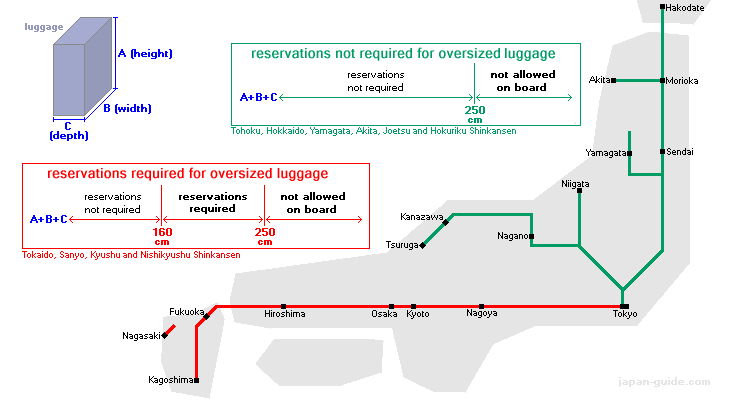
According to the rule book, each traveler is allowed to bring up to two pieces of luggage onto a train (not including small bags), with each piece not weighting more than 30 kilograms and not measuring more than 250 centimeters when adding up width, height and depth. However, even when bringing less than this upper limit, we recommend travelers with a lot of luggage to consider using a delivery service to make the trip more comfortable for themselves and the passengers around them.
Shinkansen trains are equipped with relatively spacious overhead shelves (smaller on certain train sets) which can store small and medium sized bags and suitcases. Furthermore, on many shinkansen trains the leg room is surprisingly spacious and may be large enough for your legs and a mid-sized suitcase, although this may not be the most comfortable solution.
Additionally, there is space for two or three large suitcases behind the last row of seats in each car; however, on shinkansen trains in western Japan only passengers sitting in the last row of seats are supposed to place their luggage into the space behind their seats.
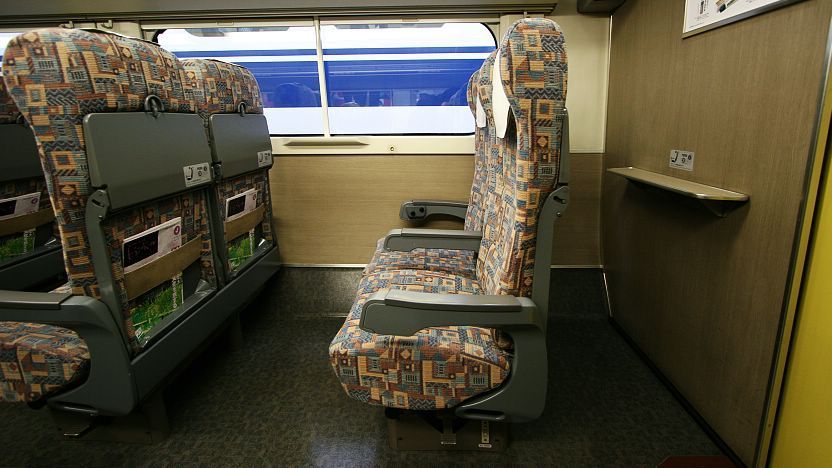
A special rule for oversized luggage applies along the Tokaido, Sanyo, Kyushu and Nishikyushu Shinkansen. Passengers with oversized luggage, i.e. luggage pieces whose height, width and depth add up to more than 160cm (63 inches), are required to make a seat reservation for specific seats in the last row of cars and place their luggage pieces behind their seats. It is not possible to bring oversized luggage into non-reserved cars.
Passengers without a reservation for their oversized luggage will be asked to move their luggage to a space specified by the train conductor and pay a 1000 yen surcharge which is not covered by the Japan Rail Pass. No plans have been announced to introduce a similar system on other shinkansen lines.
Shinkansen manners
- Line up on the platform before boarding.
- Don't block the aisle with luggage.
- When having a conversation, keep your voice down.
- Recline your seat with consideration for the person behind you. Return the seat to its original position before exiting the train.
- Set your mobile phone to silent mode. Don't talk on your phone except in the deck areas between cars.
- Take your garbage with you when getting off the train and discard it into a garbage bin on the train or in the station.
Future of the shinkansen
Several new shinkansen routes are currently being built:
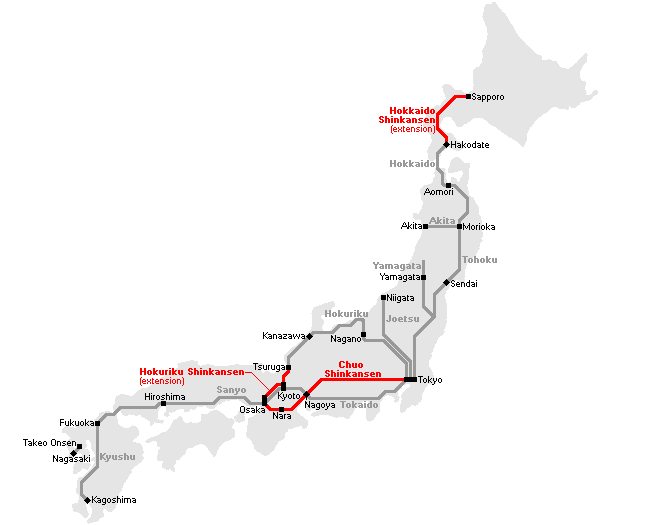
- Hokkaido Shinkansen: extension from Hakodate via Niseko and Otaru to Sapporo in the late 2030s.
- Hokuriku Shinkansen: extension from Tsuruga via Obama and Kyoto to Osaka around the 2040s.
- Chuo Shinkansen: Using maglev technology, this new line is expected to connect Tokyo with Nagoya sometime in the 2030s and then to be further extended to Osaka.
Questions? Ask in our forum.
Links and Resources
English
-
JR East Reservation System
Shinkansen online reservations for eastern Japan. -
Tokaido Sanyo Kyushu Shinkansen Online Reservation Service
Online reservations for the Tokaido/Sanyo Shinansen. -
JR West Reservation System
Shinkansen online reservations for western Japan. -
JR Kyushu Reservation System
Shinkansen online reservations for Kyushu. -
JR East
Official website. -
JR Central
Official website. -
JR West
Official website. -
JR Kyushu
Official website. -
JR Hokkaido
Official website. -
Links to timetable websites
A list of online timetable resources and explanations on how to use them. -
JR Tokai Tours
Official website of the travel agency that sells discount packages for the Tokaido Shinkansen.