by Nicola, staff writer of japan-guide.com
|
|
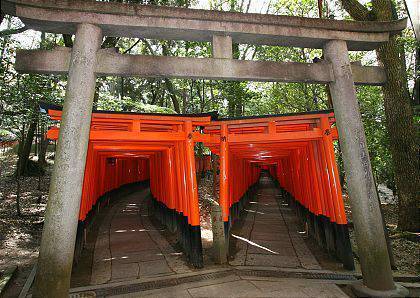
I finally took a trip to Kyoto, the former capital, a few weeks ago. Before coming to Japan, I wasn't familiar with Kyoto beyond its being the namesake of the infamous climate change protocol. This past trip finally dissasociated the two in my mind and made Kyoto a distinct place. However, rather than try to sum up the whole city (of which I only saw a very small portion), I wanted to write briefly about one of my favourite sights, Fushimi Inari Taisha.
I knew I'd like Fushimi Inari as soon as I heard the name. Inari-zushi are one of my favourite snacks here in Japan and I reasoned that any shrine sharing a name with this tasty rice and fried tofu treat must be a worthwhile sight.
As it turns out, Inari is actually the name of a shinto kami, or Japanese god. Inari presides over fertility, farming, industry and most importantly, rice. The kami is often represented by a white fox, or Kitsune. It is for this reason that statues of kitsune always appear at Inari shrines (Japanese shrines dedicated to Inari).
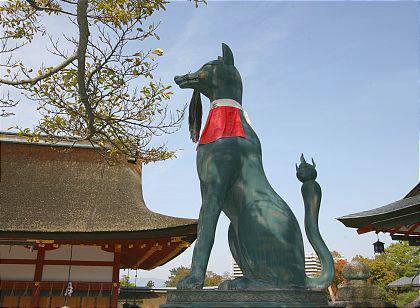
Kitsune (fox) is the name of another of my favourite snacks, Kitsune Udon, which consists of deep fried tofu in a bowl of hot udon noodle soup. As the patron kami of two of Japan's most delicious dishes, I really had no choice but to visit Fushimi Inari Taisha and pay my respects.
Fushimi Inari Taisha is the principal Inari shrine in Japan and there are stone kitsune statues to be found all over the sight. It was also one of the biggest shrines I've ever been to, covering a large area at the base of Mount Inari, to the South of Kyoto.
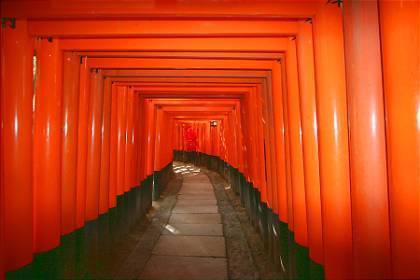
The distinctive red torii gates that mark the entrance to shrines are particularly impressive at Fushimi. Kilometres of paths lead from the main shrine up the mountain to various smaller shrine and graveyard areas. These pathways are marked by thousands of red torii gates erected within inches of one another; so tightly in fact that one feels as if they are walking through a glowing, red tunnel. Because Inari is an instrumental kami in the areas of business and industry, each of these torii have been donated by a business to ensure success and good fortune.
I could have easily spent more time at Fushimi Inari wandering the many different torii-gated paths or stopping along the way at one of the teahouses. Fushimi's red torii and stone kitsunes make it a beautiful and photogentic spot worthy of several hours out of any Kyoto trip. Even if you aren't representing a business in search of good fortune and prosperity, or a particular aficionado of the edible Inari namesakes as I am, or even all that interested in religious sites, the shrine is still one of the highlights of Kyoto, and by extention, of Japan.
|
|
| List of Posts: |