Sign in for a personalized experience.
Japan Airlines  SAKITOKU
Japan Guide Homepage
Travel
Living
A-Z
Forum
Jobs
Friends
Shopping
Essentials
-
Sightseeing
-
Accommodation
-
Transportation
-
Food
-
Budget Travel
-
Shopping
-
Questions

Search this site

Online Reservations
Hotel
 
Flight
 
Bus

(check-in)

Car Rentals Car Rentals
Compact cars from around 4,000 Yen/day!
Online Hostel Bookings Online Hostel Bookings
Hostels and inexpensive ryokan from $10 per night!
Online Ticket Bookings Online Ticket Bookings
Special fares for domestic air tickets

Related Pages
Travel
Essentials
Sightseeing

Autumn Color Report 2010
Autumn Color Report 2009
Autumn Color Report 2008

Autumn Leaves
Where to see autumn leaves?
When do trees turn colors?
What trees turn colors?
Cherry Blossoms
Nature

Japan Sightseeing Guide
Hokkaido
Sapporo
Otaru
Hakodate
Asahikawa
Furano
Abashiri
Noboribetsu
Niseko
Lake Toya
Daisetsuzan
Shiretoko
Rishiri Rebun
Akan

Tohoku
Sendai
Matsushima
Hiraizumi
Akita
Kakunodate
Hachimantai
Aomori
Hirosaki
Lake Towada
Shimokita Hanto
Dewa Sanzan
Yamadera
Aizu
Bandai
Iwaki

Kanto
Tokyo
Yokohama
Kamakura
Hakone
Kawasaki
Nikko
Kinugawa
Kawagoe
Kusatsu
Ikaho
Minakami
Oze
Narita
Ogasawara

Chubu
Nagoya
Inuyama
Mt.Fuji
Fujigoko
Izu Peninsula
Shizuoka
Hamanako
Nagano
Bessho Onsen
Matsumoto
Kamikochi
Kiso Valley
Hakuba
Yamanouchi
Sado Island
Takayama
Okuhida
Shirakawa-go
Gujo
Gero Onsen
Kanazawa
Kaga Onsen
Noto Peninsula

Kansai
Kyoto
Osaka
Nara
Kobe
Himeji
Kinosaki
Mount Koya
Kumano
Asuka
Yoshino
Amanohashidate
Hikone
Iga Ueno
Ise Shima

Chugoku
Hiroshima
Miyajima
Onomichi
Okayama
Kurashiki
Takahashi
Inujima
Tottori
Daisen
Matsue
Iwami Ginzan
Iwakuni
Yamaguchi
Hagi

Shikoku
Takamatsu
Kotohira
Naoshima
Shodoshima
Matsuyama
Uchiko
Kochi
Tokushima
Naruto

Kyushu
Fukuoka
Dazaifu
Arita
Nagasaki
Shimabara
Kumamoto
Mount Aso
Kurokawa
Minamata
Beppu
Yufuin
Mount Kuju
Miyazaki
Takachiho
Kagoshima
Kirishima
Satsuma Hanto
Yakushima

Okinawa
Honto
Kume
Miyako
Yaeyama

Survey
Have you visited Japan in the last 3 years?
Yes
No
see results
Other Surveys:
Preferred Airport
Favorite hotel reservation website
Favorite travel guide books
How to improve tourism
Next trip to Japan
Purpose of visit
Most popular region
Have you recently entered Japan?

japan-guide.com newsletter
Keeping you up to date on Japan travel and living related issues and site updates. Click here to subscribe!

Sponsored Listings
Car Rental
The cheapest rates in Japan!
Tour Packages
Guided and individual tour plans.
Japan - Order FREE Brochure!
About vacation plans and specialty travel.

Home - Travel - Essentials - Autumn Leaves
What trees turn colors?

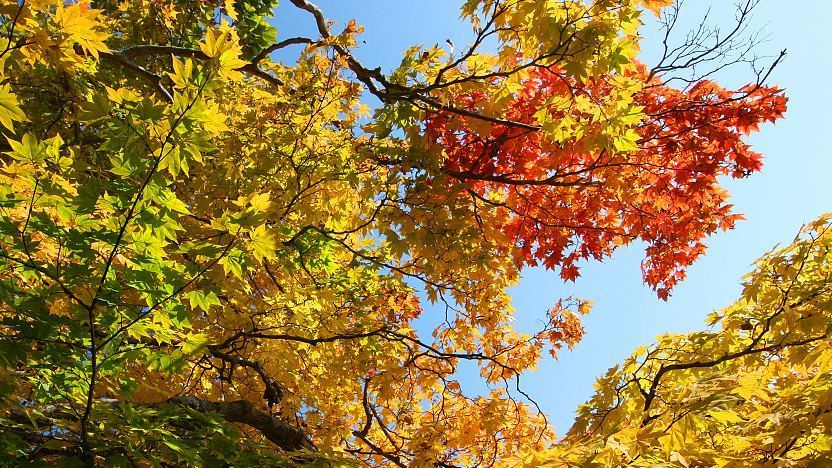
A single maple tree displays a whole range of colors

The maple tree is the indisputable king of autumn colors. As a matter of fact, the word "autumn colors" (pronounced: koyo) is written with the same kanji characters as the word "maple tree" (pronounced: momiji). Maple trees are native to Japan and can be seen in their wild form in forests. Furthermore, humans have cultivated over a hundred varieties of maple trees over the centuries for decorative use.

It is some of these cultivated maple tree varieties that come with the most brilliant autumn colors, turning gradually from a beautiful green into yellow, orange and finally a shiny red. Maple trees are used widely in Japanese gardens, and the temples and traditional gardens of Kyoto are some of the best places to admire them. But they are also encountered in forests, mountains and city parks.

Icho Namiki (Ginkgo Avenue) in Tokyo

Arguably the second most popular tree for autumn colors is the ginkgo (Japanese: icho). The leaves of the ginkgo trees do not turn red. Instead they turn into one of the most brilliant yellow colors that nature has to offer. Ginkgo trees are more easily found in temples, shrines, urban parks and along city streets than in nature. The Metropolis of Tokyo has chosen the ginkgo as its symbol tree.

The variety of trees found in the mountains naturally differs somewhat from that found in the cities and gardens, especially in the higher elevations. The king of autumn colors in the higher elevations of mountainous Japan is the nanakamado (Japanese Rowan), a shrub whose leaves behave similarly spectacular as the leaves of the maple tree. The nanakamado offers particularly nice sights above the tree line where the shrub sometimes monopolizes entire mountain slopes.

Nanakamado shrubs in Daisetsuzan National Park

Another beautiful tree in the higher elevations is the Japanese larch (karamatsu), the only conifer to change colors (and lose its needle shaped leaves) in autumn. The larch tree rivals the ginkgo tree with its brilliant yellow colors.

Among the many other trees and shrubs found in Japan, some produce nice autumn colors, while others go directly from green into an unremarkable brown. Among the more attractive other trees are the Japanese zelkova (keyaki), the beech (buna), the Japanese horse chestnut (tochinoki), various vines, the birch (shirakaba), the Japanese lacquer tree (urushi) and rhododendron (tsutsuji). The leaves of cherry trees (sakura) also changes into a reddish orange, but not a particularly brilliant one.

A final contributor to autumn colors are grasses. Known as kusamomiji (grass autumn colors), some types of grasses in marshlands and on mountainous plains and slopes can provide attractive yellow colors that sometimes fade into a fascinating red. The marshland of Oze National Park is one of the nicest places to enjoy autumnal grass.

Cherry trees in autumn
A yellow larch tree and colorful grass in Okunikko

Guide to Autumn Colors:

Any Questions? Ask them in our question forum.

Advertisements

Travel Community
User Feedback
We strive to keep japan-guide.com up-to-date and accurate, and are always looking for ways to improve the user experience. If you have any updates, suggestions, corrections or opinions, please let us know:

Travel
Living
Japan A-Z
Community
Sightseeing
Accommodation
Transportation
Shopping
Essentials
Regions
Prefectures
Cities
Working
Studying
Living Cost
Apartments
Arts and Crafts
Entertainment
History
Religion
Etiquette
Food
Language
Tradition
Question Forum
Classifieds
Trip Reports
Member Area
 
126 users are currently online: Rosaly, Youness, Lamperouge, mikesoka, Tigrella, grey eyes, Francisco90, aLeKsAnDa, Caitlin Michele Rose, elizabeth1997, mitakoro, keeeii, haru359, Camille8, K Hinako, Lukas93, tara0420, isurudono, Sam Sen, tsuo yeh, digity20, akitaka0708, Reemii, claudefr, ccee, xskysharkx, bicicletta, juco, rinyouna, remi tama, Kiddroc11, Garrett1, keith mea, Misha77, Luccas, saoryyy, TYS, kou0000, LeeAnneR, parastais, Ayanora, sclyj1005, bamboo0217, sayel, Chika85, kanaxx5, cool down, kenji fujimoto, kashkoi canadian187, Dean1981, Sho16, Gaumut, DY1590, Eikan, Peterjw5, jiro39, Fizzi , Francesco 14, haian, noj53, Takachan77, JanuaryJanine, Sara Ch, shoukin, TommyHorse, 5hinji, Vecvero, Rui1, James17, Yus6, utaiya111, AyuGerman, Jiuly, centerofjava, takashik80, yojimbo36, Yannickitsune, dora, fufu t, sprr8449, Passionatesoul, faceface, Risa in BKK, Ryuki32, jillfillfull, samisamia, mamemon, yurikong, RKaji, Crusier95, Blue sleep, Yuki1209, AnaDean, xxshiratamaxx, Miavi, Darkphonix, Mr Vega, Tsubasa83, rumble fish, GC3, Jeff1234, IncredibleRan, javin90, tsuz, Tobira, Hideyuki Y, suijyoujikouki, Selenaa, kino197618, heeling, CloudStar, MoonChild23, yume123, yumeichi, reimondodesu, Najira, junaline, cheb0223, non111729, joewolf, keke chan, Alicat2k14, kiyusuya, renpee9147, Suren76, Fendolyn
Sign in for a personalized experience.
 
Copyright © 1996-2012 japan-guide.com All rights reserved - Last Page Update: September 12, 2010
home - site map - privacy policy - terms of use - contact - employment - L‚ɂ‚¢‚Ä - advertising