Limited express trains
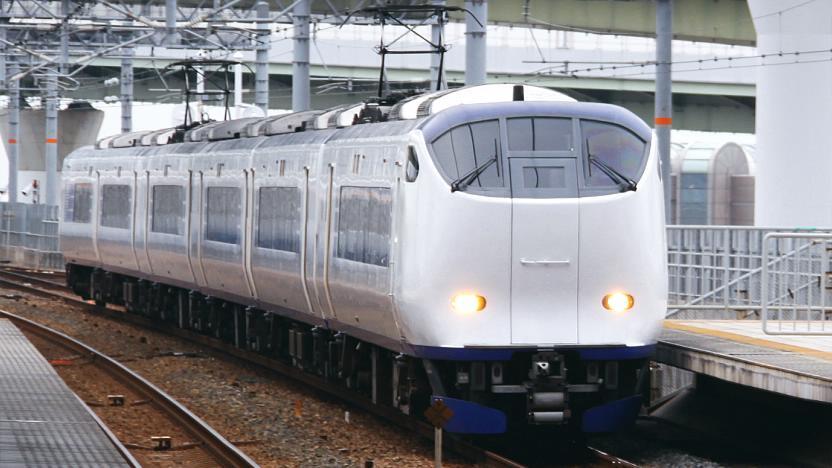
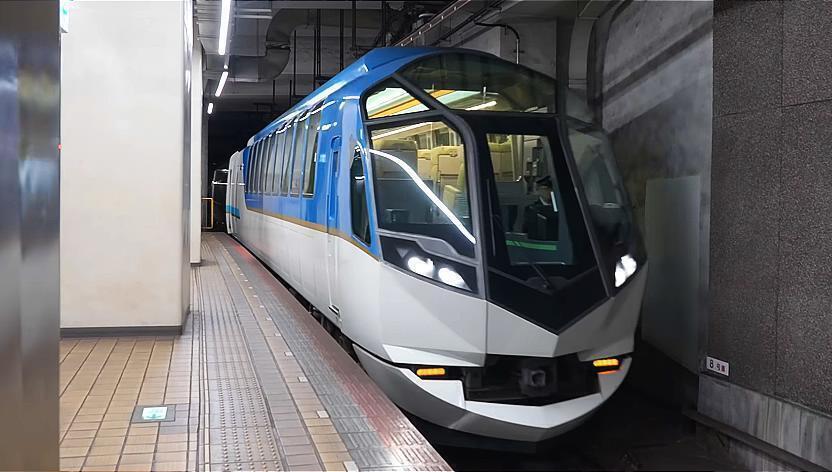
Limited express trains (特急, tokkyū, lit. "special express") are the fastest trains in Japan after the shinkansen (bullet trains). With a few exceptions, they travel over long distances between different cities or regions and serve only major stations along their way.
Because of their greater speed, travelers have to pay a supplement fee (limited express fee) to ride most of them. But unlike the shinkansen, limited express trains share the railway tracks with slower train categories, such as local and rapid trains.
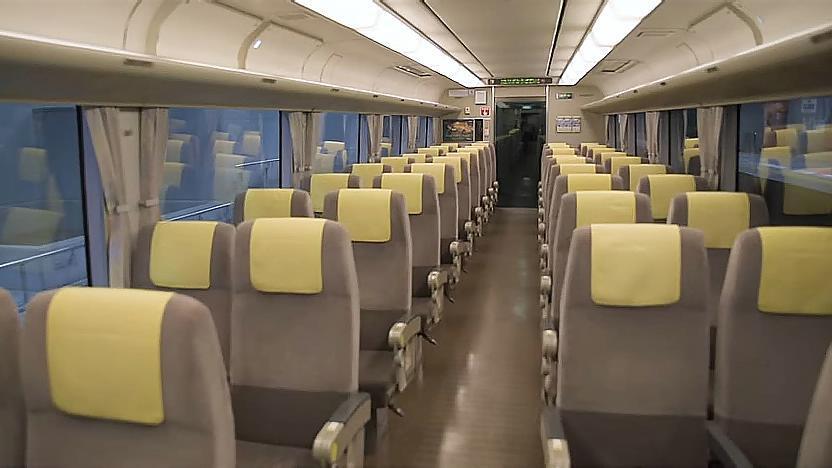
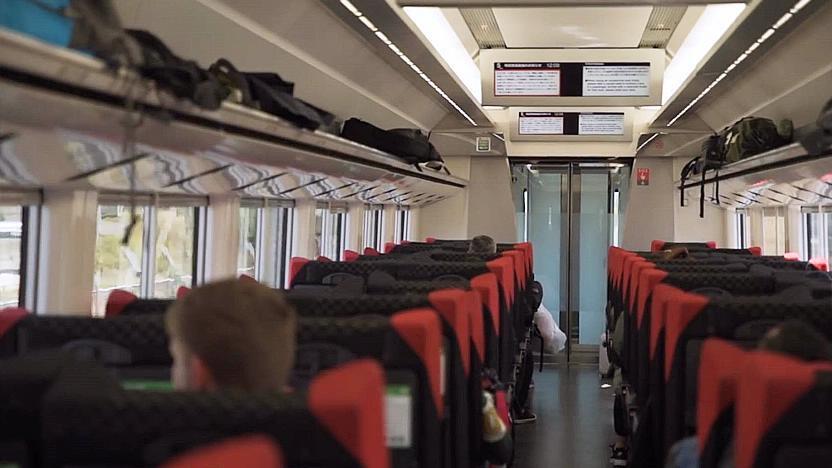
Limited express trains typically offer reclinable, forward-facing seats, which often feature a table and - in case of newer train sets - power outlets. Multiple toilets are found on board.
Which railway companies operate limited express trains?
Several train companies in Japan operate limited express trains. In particular, the JR companies are operating a large number of limited express trains across Japan (see map below), especially between major stations and cities not connected to the shinkansen network.
Among non-JR companies, quite a few operate limited express trains, but only a handful charge a limited express fee like JR, while the other companies do not require a surcharge for riding their limited express trains, which tend to be suburban rather than interregional. See the map below to see a list of non-JR limited express trains.
Tickets
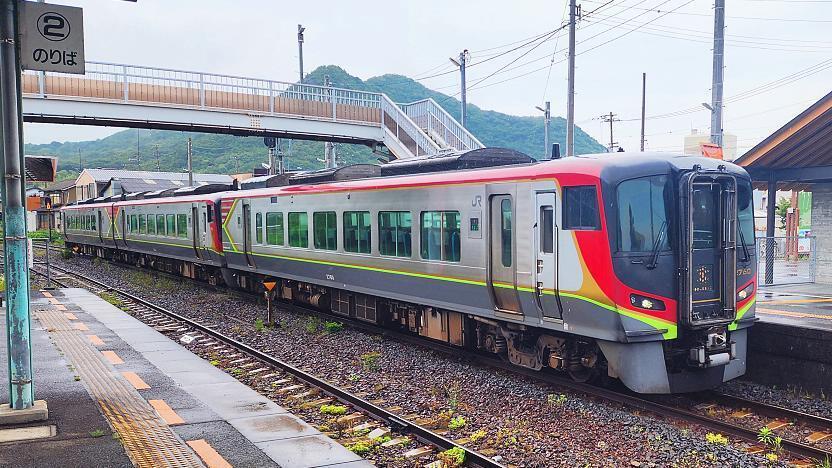
In order to ride most limited express trains, you need to pay a limited express fee (also known as supplement fee or express fee) in addition to the base fare. Both are calculated on the distance traveled. For example, the base fare from Hakodate to Sapporo is 6600 yen and the limited express fee is 3170 yen based on the 319 kilometers traveled.
How to pay the base fare
The base fare can be paid with a paper ticket or - in some cases - with an IC card:
Base fare paper tickets can be purchased at ticket offices or ticket machines, or online and picked up at a ticket machine before use.
If your departure and arrival stations are located within the same IC card area, you can pay the base fare with an IC card, such as Suica or Icoca, by tapping the card at the ticket gates. However, the use of IC cards is not possible if the arrival or departure station is located outside the area covered by IC cards or the stations are located in separate IC card areas (e.g. one in the Suica and one in the Icoca area). A paper ticket is required in such cases. Depending on the route, a paper ticket may also be required for journeys of more than 200 kilometers.
How to pay the limited express fee
The limited express fee can be paid with a paper ticket or - for some trains - with an e-ticket:
Limited express fee paper tickets can be purchased at ticket offices or ticket machines, or online and picked up at a ticket machine before use. Most people buy the base fare and limited express fee tickets at the same time, but you can also purchase them separately.
For a small number of JR trains (mainly around Tokyo) and for many non-JR trains, it is possible to purchase the limited express fee as paperless e-tickets without the need to pick up a physical ticket. If you use an e-ticket, keep your confirmation screen or email ready to find your seat or to show it to a conductor if asked for it. Note that conductors do not usually check tickets unless you sit on a reserved seat that is not supposed to be occupied. But there are exceptions. Our list of trains below indicates for which trains e-tickets are available.
Can I pay the limited express fee on board of the train?
The limited express fee should generally be purchased before boarding the train. On some trains it can be purchased on board from the conductor; however, the fee may be higher and you may not be able to sit. In rare cases, you may be asked to get off.
Are there any limited express trains that don't require a supplement fee?
Yes, there are several suburban railway companies, including Keio, Tokyu, Keikyu, Hanshin, Hankyu, Keihan and Nishitetsu, which operate "limited express" trains but do not charge a limited express fee. They tend to be suburban trains and are not the main subject of this page.
Seat reservations
Are seat reservations required?
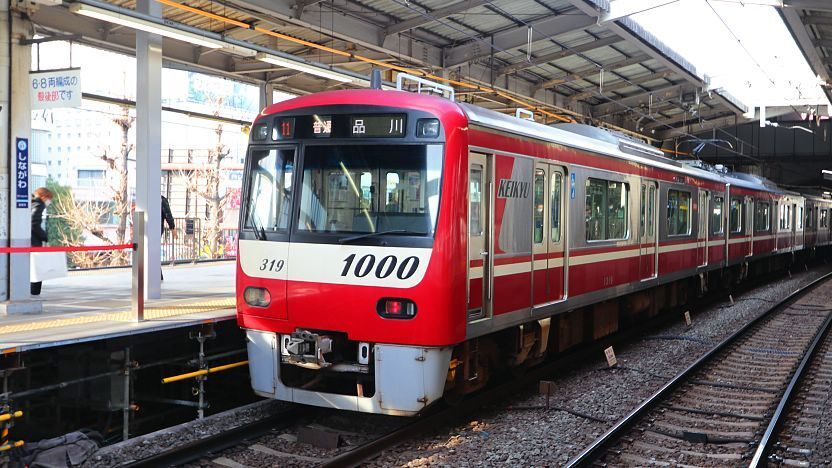
Many limited express trains require a seat reservation, while others also offer unreserved seating (see the list below for details on each train). Green car (business class) seating or premium seats are also available on many limited express trains and almost always require a reservation. The number of all-reserved trains has been on the increase in recent years, and the trend is expected to continue.
How do I make a seat reservation?
The seat reservation is made at the time the limited express ticket is purchased, which - as covered above - can be done at a ticket office, ticket machine or online. Note that if you have a rail pass that covers limited express trains, the seat reservation process is a bit different. Seat reservations can be made from one month before the travel date.
How much do seat reservations cost?
The fee for seat reservations is included in the limited express fee. The limited express fee for reserved seats is a few hundred yen higher than the limited express fee for unreserved seats. The difference is typically 530 yen, but on many trains, there are seasonal variations, with the difference ranging between 330 and 930 yen, while on other trains the fee remains the same year round (see the list below for details on each train).
What if a train is fully booked and does not carry unreserved seats?
Trains that carry unreserved seating cannot sell out, because passengers can always board and use the unreserved cars without booking a seat. But what happens if an all-reserved train is fully booked?
On many limited express trains without unreserved seating, it is possible to purchase a standing ticket when all seats are sold out. These tickets can be bought at ticket offices and machines and allow passengers to stand in the ordinary cars, but not in the Green Cars.
On selected limited express trains in the Tokyo and Hokkaido regions, it is also possible to ride an all-reserved train with a "limited express ticket without seat assignment" or with a rail pass that covers the specific train. In this case, you may sit in any unoccupied seat; however, if another passenger with a reservation for that seat arrives, you must vacate the seat. If no vacant seats are available, you can stand in the ordinary cars, but not in the Green Cars.
What if I have a rail pass?
Many rail passes, including the Japan Rail Pass and many regional JR passes, fully cover limited express trains. If your pass does, you can use unreserved seats on limited express trains simply with your pass, with no additional steps required. However, if you wish to use a reserved seat, you must make a seat reservation before boarding, which is free with many passes.
How to make seat reservations with a rail pass that covers limited express trains?
Seat reservations can be made at ticket offices or ticket machines. Online reservations are possible only in some situations and still require pass holders to pick up physical tickets at a ticket machine or office before their journey. These situations include the following:
- Official Japan Rail Pass website: If you purchase your pass via the official Japan Rail Pass website (as opposed to other sales channels), you can use a dedicated website for making online seat reservations.
- JR East Reservations website: Online seat reservations for selected limited express trains in eastern Japan are possible for pass holders of several regional JR passes (but not the nationwide Japan Rail Pass) via the JR East Reservations website.
- Official JR West website: If you purchase a regional rail pass for western Japan via the official JR West website (as opposed to other sales channels), you can use a dedicated website for making online seat reservations.
- JR Kyushu Rail Pass Online Booking: Online seat reservations for Kyushu Rail Pass holders are possible if the pass is purchased through the official Kyushu Rail Pass website or other selected sales channels; however, there is a fee of 1000 yen per reservation!
Do all rail passes cover limited express trains?
No, there are many rail passes that cover only the base fare and do not cover the limited express fee, including the Hakone Free Pass, the Nikko Pass, the Kintetsu Rail Pass and the Seishun 18 Kippu. If you wish to ride a limited express with such a pass, you must purchase the limited express fee separately at a ticket office or machine or online, if available.
List of JR limited express trains
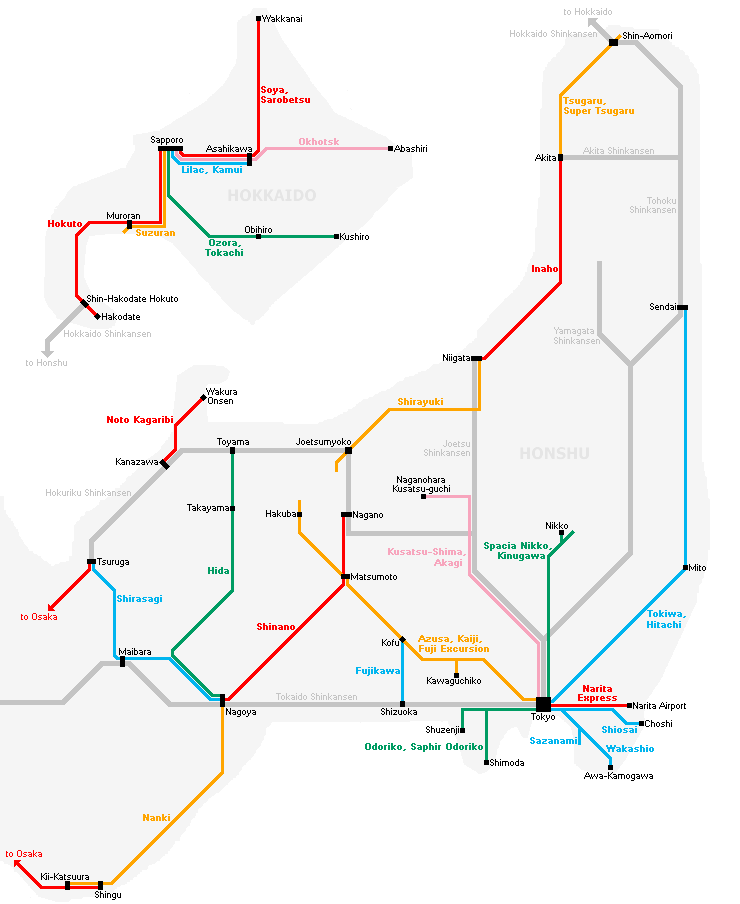
Japan Railways (JR) offer particularly many limited express trains, which tend to serve major cities not yet connected to the shinkansen network. The maps and lists below show the major JR limited express trains in eastern and western Japan. Some infrequent ones are omitted.
Hokkaido
- Soya, Sarobetsu (Sapporo - Asahikawa - Wakkanai)
All reserved seating - no seasonal fare variationWhile the Soya travels all the way between Sapporo and Wakkanai, the Sarobetsu travels only between Asahikawa and Wakkanai.
- Okhotsk (Sapporo - Asahikawa - Abashiri)
All reserved seating - no seasonal fare variationThe Okhotsk connects Sapporo and Asahikawa with Abashiri.
- Lilac, Kamui (Sapporo - Asahikawa)
All reserved seating - no seasonal fare variationThe Lilac and Kamui both run between Hokkaido's two largest cities, Sapporo and Asahikawa. They differ from each other in the train sets used.
- Ozora, Tokachi (Sapporo - Obihiro - Kushiro)
All reserved seating - no seasonal fare variationWhile the Ozora travels all the way between Sapporo and Kushiro, the Tokachi travels only between Sapporo and Obihiro.
- Suzuran (Sapporo - Muroran)
All reserved seating - no seasonal fare variationThe Suzuran connects Sapporo with Muroran, stopping at Noboribetsu along the way.
- Hokuto (Sapporo - Hakodate)
All reserved seating - no seasonal fare variationThe Hokuto connects Sapporo with Hakodate, stopping at Noboribetsu, Toya and Onuma Park along the way.
Tohoku
- Tsugaru, Super Tsugaru (Akita - Aomori)
Reserved and unreserved seating - fare varies seasonallyThe Tsugaru and Super Tsugaru connect Akita with Aomori, stopping at Hirosaki along the way. The Super Tsugaru stops at fewer stations than the Tsugaru.
- Inaho (Niigata - Akita)
Reserved and unreserved seating - fare varies seasonallyThe Inaho connects Niigata with Akita, stopping at Tsuruoka near the Dewa Sanzan and at Sakata along the way.
Kanto
- Tokiwa, Hitachi (Tokyo - Mito - Iwaki - Sendai)
All reserved seating - no seasonal fare variation - e-tickets availableThe Tokiwa and Hitachi operate from central Tokyo (Shinagawa, Tokyo and Ueno stations among others) along the Joban Line to Mito, Iwaki and Sendai. While Tokiwa trains do not operate beyond Ibaraki Prefecture in the north, Hitachi trains run as far as Iwaki in Fukushima Prefecture and beyond.
- Spacia Nikko, Kinugawa (Tokyo - Nikko/Kinugawa)
All reserved seating - no seasonal fare variationThe Spacia Nikko and Kinugawa operate from Tokyo's Shinjuku Station to Nikko (Tobu-Nikko Station) and Kinugawa Onsen respectively. The trains partially use the railway tracks of Tobu Railway, and are therefore not fully covered by some JR rail passes. However, thanks to a special agreement, they are fully covered by the JR Tokyo Wide Pass, JR East Pass and JR East South Hokkaido Pass.
- Kusatsu-Shima, Akagi (Tokyo - Takasaki - Kusatsu Onsen)
All reserved seating - no seasonal fare variation - e-tickets availableThe Kusatsu-Shima operates from Tokyo's Ueno Station to Naganohara-Kusatsuguchi Station, from where the hot spring resort of Kusatsu Onsen can be reached in a 30 minute bus ride. The Akagi operates only as far as Takasaki and targets commuters.
- Narita Express (Yokohama - Tokyo - Narita Airport)
All reserved seating - no seasonal fare variation - e-tickets availableThe Narita Express connects Tokyo's Narita Airport with central Tokyo (Tokyo, Shinagawa, Shibuya and Shinjuku stations) and Yokohama.
- Shiosai, Wakashio, Sazanami (Tokyo - Boso Peninsula)
All reserved seating - no seasonal fare variation - e-tickets availableThe Shiosai connects Tokyo Station with the coastal city of Choshi, while the Wakashio connects Tokyo Station with Katsuura and Awa-Kamogawa on the eastern coast of the Boso Peninsula. Lastly, the Sazanami targets commuters between Tokyo Station and Kimitsu on the western coast of the peninsula. On selected days, it also caters to tourists as "Shinjuku Sazanami", when it runs from Shinjuku Station all the way to Tateyama.
- Odoriko, Saphir Odoriko (Tokyo - Izu Peninsula)
All reserved seating - no seasonal fare variation - e-tickets availableThe Odoriko connects Tokyo Station with Izukyu-Shimoda Station on the Izu Peninsula. Some trains are split at Atami Station, with one half continuing to Shuzenji Onsen. On the peninsula, the trains operate partially on non-JR tracks and are not fully covered by the Japan Rail Pass. However, they are fully covered by many regional JR passes, such as the Tokyo Wide Pass. The Saphir Odoriko is a luxury version of the Odoriko, which carries only Green Car and Premium Green Car seats.
Yamanashi/Nagano/Niigata
- Azusa, Kaiji, Fuji Excursion (Tokyo - Kofu - Matsumoto)
All reserved seating - no seasonal fare variation - e-tickets availableThe Azusa connects Tokyo's Shinjuku Station (a few also Tokyo Station) with Matsumoto and rarely to Hakuba. Kaiji trains operate only as far as Kofu. Lastly, there are a few Fuji Excursion trains (Fuji Kaiyu in Japanese), which branch off at Otsuki and travel to Kawaguchiko Station at the base of Mount Fuji. Note that the section beyond Otsuki is non-JR and not covered by most JR passes. One exception is the Tokyo Wide Pass.
- Fujikawa (Kofu - Shizuoka)
Reserved and unreserved seating - fare varies seasonallyThe Fujikawa connects Kofu with Shizuoka via Minobu.
- Shirayuki (Niigata - Joetsumyoko - Arai)
Reserved and unreserved seating - fare varies seasonallyThe Shirayuki connects Niigata with Joetsumyoko Station, providing a connection between the Hokuriku Shinkansen, the Joetsu Shinkansen and Niigata City. Note that it runs on non-JR tracks between Naoetsu, Joetsumyoko and Arai, and is not fully covered by the Japan Rail Pass. However, it is fully covered by the JR East Pass.
- Shinano (Nagoya - Matsumoto - Nagano)
Reserved and unreserved seating - fare varies seasonallyThe Shinano connects Nagano, Matsumoto, the Kiso Valley and Nagoya. It usually features both unreserved and reserved seating, but turns fully-reserved during major holiday seasons.
Gifu/Hokuriku/Mie
- Hida (Nagoya - Takayama - Toyama)
Reserved and unreserved seating - fare varies seasonallyThe Hida connects Nagoya with Gifu, Gero Onsen and Takayama. A few trains continue to Toyama. One round trip per day also runs to/from Osaka. The Hida usually features both unreserved and reserved seating, but turns fully-reserved during major holiday seasons.
- Shirasagi (Nagoya - Tsuruga)
All reserved seating - fare varies seasonallyThe Shirasagi connects Nagoya with Tsuruga, where many travelers transfer to the Hokuriku Shinkansen in the direction of Fukui and Kanazawa.
- Noto Kagaribi (Kanazawa - Wakura Onsen)
Reserved and unreserved seating - fare varies seasonallyThe Noto Kagaribi connects Kanazawa with Wakura Onsen on the Noto Peninsula. Note that it runs partially on non-JR tracks; nevertheless, it is covered by the Japan Rail Pass and regional JR passes.
- Nanki (Nagoya - Kumano)
Reserved and unreserved seating - fare varies seasonallyThe Nanki connects Nagoya with the Kumano Region. It usually features both unreserved and reserved seating, but turns fully-reserved during major holiday seasons.
Kansai
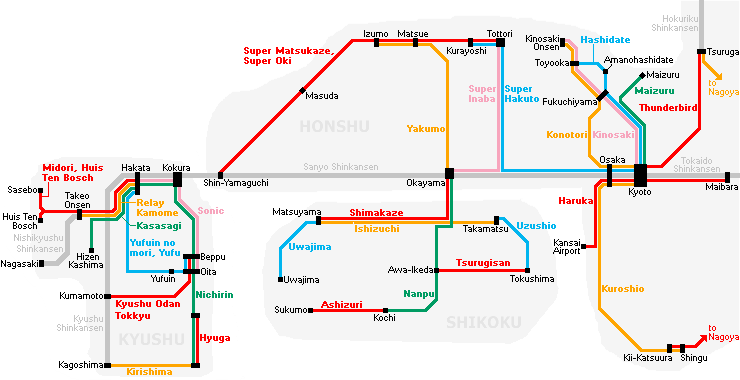
- Haruka (Kyoto - Osaka - Kansai Airport)
Reserved and unreserved seating - fare varies seasonallyThe Haruka connects Kansai Airport with central Osaka (Tennoji, Osaka and Shin-Osaka stations) and Kyoto.
- Thunderbird (Osaka - Kyoto - Tsuruga)
All reserved seating - fare varies seasonallyThe Thunderbird connects Osaka and Kyoto with Tsuruga, where many travelers transfer to the Hokuriku Shinkansen in the direction of Fukui and Kanazawa.
- Hashidate, Kinosaki, Konotori, Maizuru (Osaka/Kyoto - Fukuchiyama - Kinosaki Onsen/Maizuru)
All reserved seating - fare varies seasonallyThe Kinosaki connects Kinosaki Onsen to Kyoto and the Konotori to Osaka, while the Maizuru connects Kyoto with Maizuru. The Hashidate runs from Kyoto via Fukuchiyama to Amanohashidate (some trains continue to Toyooka), using non-JR tracks beyond Fukuchiyama. While the Japan Rail Pass does not cover the non-JR section, most regional JR rail passes covering the area do thanks to an exception.
- Kuroshio (Osaka - Kumano)
All reserved seating - fare varies seasonallyThe Kuroshio connects Osaka via Wakayama City with the Kumano Region. A small number of trains also serve Kyoto.
Chugoku
- Super Hakuto, Super Inaba (Osaka/Okayama - Tottori)
All reserved seating - fare varies seasonallyThe Super Hakuto and Super Inaba provide the fastest connections to Tottori from Osaka and Okayama respectively. The trains operate partially on non-JR tracks and are not fully covered by the Japan Rail Pass. However, they are fully covered by many regional JR passes.
- Yakumo (Okayama - Matsue - Izumo)
All reserved seating - fare varies seasonallyThe Yakumo connects Okayama with Bitchu-Takahashi, Matsue and Izumo.
- Super Oki, Super Matsukaze (Shin-Yamaguchi - Izumo - Matsue - Tottori)
Reserved and unreserved seating - fare varies seasonallyThe Super Oki and Super Matsukaze connect Tottori, Yonago, Matsue, Izumo, the Iwami Ginzan region and Masuda, with the Super Oki going all the way to Shin-Yamaguchi. They are scheduled to turn all-reserved from spring 2027.
Shikoku
- Shimakaze, Ishizuchi (Matsuyama - Okayama/Takamatsu)
Reserved and unreserved seating - fare varies seasonallyThe Shimakaze connects Matsuyama with Okayama, and the Ishizuchi with Takamatsu. Many of them are coupled to each other between Matsuyama and Utazu. The Shimakaze (but not the Ishizuchi) is scheduled to turn all-reserved from spring 2027.
- Nanpu (Kochi - Okayama)
Reserved and unreserved seating - fare varies seasonallyThe Nanpu connects Kochi with Okayama. The Nanpu is scheduled to turn all-reserved from spring 2027.
- Uzushio (Takamatsu - Tokushima)
Reserved and unreserved seating - fare varies seasonallyThe Uzushio connects Takamatsu with Tokushima.
- Tsurugisan (Tokushima - Awa-Ikeda)
Reserved and unreserved seating - fare varies seasonallyNamed after one of Shikoku's tallest mountains, Mount Tsurugi, the Tsurugisan connects Tokushima with Awa-Ikeda near the Iya Valley.
- Uwajima (Matsuyama - Uwajima)
Reserved and unreserved seating - fare varies seasonallyThe Uwajima connects Matsuyama with Uchiko, Ozu and Uwajima.
- Ashizuri (Kochi - Sukumo)
Reserved and unreserved seating - fare varies seasonallyThe Ashizuri connect Kochi with Sukumo.
Kyushu
- Relay Kamome, Midori, Huis Ten Bosch (Hakata - Takeo Onsen - Sasebo)
Reserved and unreserved seating - fare varies seasonallyThe Relay Kamome provide a connection between Hakata and Takeo Onsen, where many travelers transfer to the Nishikyushu Shinkansen in the direction of Nagasaki. Midori and Huis Ten Bosch trains continue beyond Takeo Onsen to Sasebo and Huis Ten Bosch respectively, serving Arita along the way.
- Kasasagi (Hakata - Hizen-Kashima)
Reserved and unreserved seating - fare varies seasonallyThe Kasasagi connects Hakata with Hizen-Kashima, home of Yutoku Inari Shrine.
- Sonic, Nichirin, Hyuga (Hakata - Beppu - Oita - Miyazaki)
Reserved and unreserved seating - fare varies seasonallyThe Sonic connects Hakata with Kokura, Beppu and Oita. Nichirin trains continue beyond Oita all the way to Miyazaki, while Hyuga trains operate only within Miyazaki Prefecture between Nobeoka and Miyazaki.
- Yufuin no mori, Yufu (Hakata - Yufuin - Beppu)
Reserved and unreserved seating - fare varies seasonallyThe Yufuin no mori is an all-reserved sightseeing train, which operates between Hakata and Yufuin, while the Yufu is a standard limited express which also carries unreserved seating and travels beyond Yufuin to Oita and Beppu.
- Kyushu Odan Tokkyu, Aso Boy (Kumamoto - Aso - Oita - Beppu)
Reserved and unreserved seating - fare varies seasonallyThe Kyushu Odan Tokkyu or "Trans Kyushu Limited Express" operates between Kumamoto and Oita/Beppu via Aso. Along the same line also operates the Aso Boy limited express (or Kawasemi Yamasemi on selected days); however, it operates only between Kumamoto and Aso (Miyaji Station) and is all-reserved.
- Kirishima (Kagoshima-Chuo - Miyazaki)
Reserved and unreserved seating - fare varies seasonallyThe Kirishima connects Kagoshima with Miyazaki.
Not included in the above list is the limited express Sunrise Izumo/Seto, the last surviving regular JR overnight train, which connects Tokyo with Izumo and Takamatsu. Advance reservations are required to ride the Sunrise Izumo/Seto.
List of non-JR limited express trains
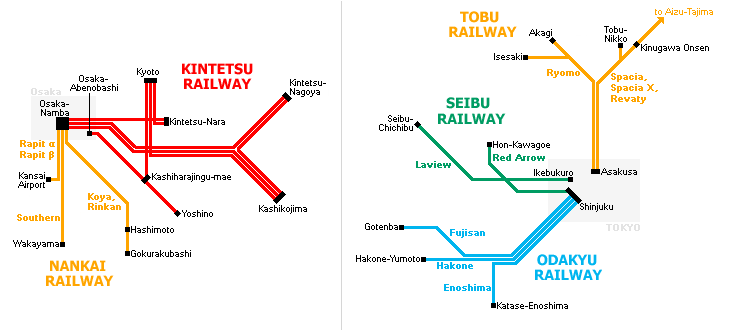
Many non-JR railway companies also offer limited express trains, but only a selected number of them require a limited express fee, while the others don't require an additional fee and tend to operate only shorter urban and suburban train lines. The map below shows the major non-JR limited express trains that do require a supplement fee.
- Odakyu Railway
All reserved seating - no seasonal fare variation - e-tickets availableOdakyu Railway operates so called "Romancecar" limited express trains from Tokyo's Shinjuku Station to Hakone, Enoshima and Gotemba.
- Tobu Railway
All reserved seating - fare varies seasonally - e-tickets availableTobu Railway operates limited express trains from Tokyo's Asakusa Station to Nikko and Kinugawa Onsen, as well as Isesaki and Akagi in Gunma Prefecture.
- Seibu Railway
All reserved seating - no seasonal fare variationSeibu Railway operates limited express trains from Shinjuku to Kawagoe and from Ikebukuro to Chichibu.
- Kintetsu Railway
All reserved seating - no seasonal fare variation - e-tickets availableKintetsu Railway operates the most extensive network after the JR Group. It connects Osaka with Kyoto, Nara, Nagoya and the Shima Peninsula, and limited express trains operate between most of these destinations.
- Nankai Railway
All reserved seating - no seasonal fare variation - e-tickets availableNankai Railway operates limited express trains along its three main lines from Osaka to Kansai Airport, Wakayama City and Koyasan.
For technical reasons, we did not include in the above list the Keisei Skyliner, which connects Tokyo's Ueno and Nippori stations with Narita Airport (because it is a special type of limited express), and the all-reserved Meitetsu airport trains, which connect Nagoya with Central Japan Airport (because they require a premium seat fee rather than a limited express fee).
Questions? Ask in our forum.