Credit card tap payment on trains
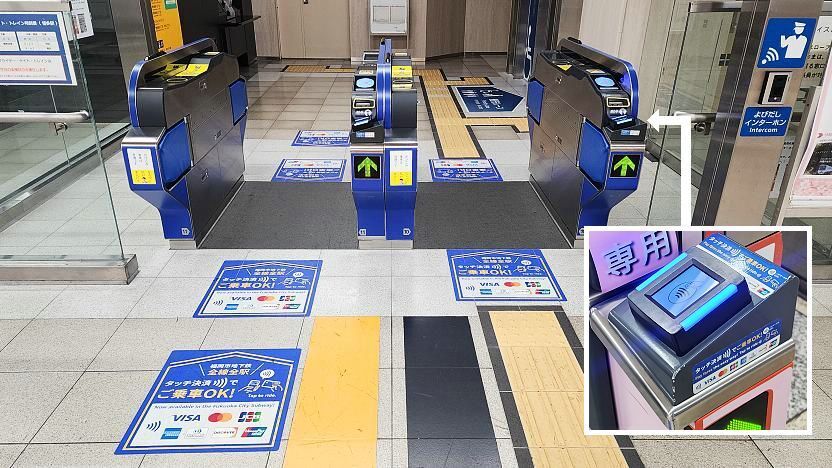
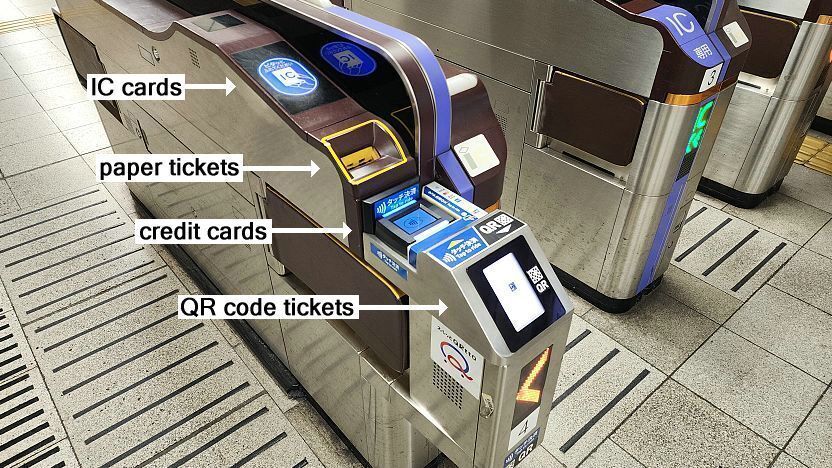
Contactless credit card payment (タッチ決済, touch kessai) has gradually become more common at stations and in buses and trams in Japan, allowing travelers to pay their fares simply by tapping their card to a reader on the ticket gate or on the bus as an alternative to using paper tickets, IC cards and QR code tickets.
However, the acceptance of tap-to-pay remains far from universal, and will likely remain limited. Most prominently, the major Japan Railways (JR) companies are reluctant to offer contactless credit card fare payments. It currently looks unlikely that all JR companies will introduce contactless credit card payment at their ticket gates anytime soon, which means that you won't be able to use your credit card to tap onto a majority of trains in Japan.
Which companies accept tap-to-pay?
An increasing number of transport companies nationwide are accepting contactless credit card payments, and tourists will most easily notice them on non-JR transportation in the major urban areas. You can see a list of companies accepting tap-to-pay in Japanese here.
Tokyo
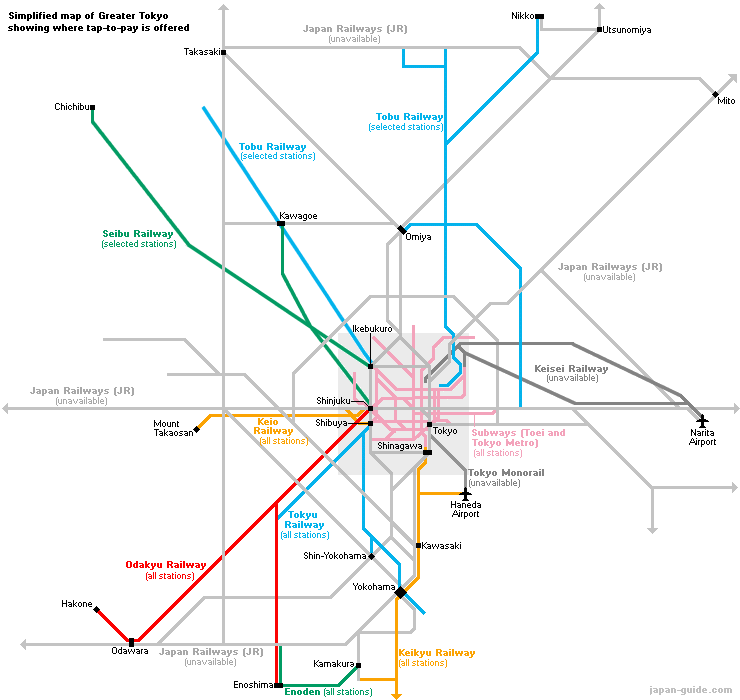
Tap-to-pay is available on many trains in and around Tokyo, including the subways. The prominent exceptions are JR (which operate the Yamanote Line and many other useful train lines around the city), Keisei Railway (which operates trains to Narita Airport among other destinations) and the Tokyo Monorail (to Haneda Airport).
- Accepted at all/most stations: Tokyo Metro, Toei, Odakyu, Keio, Tokyu, Keikyu, Yurikamome, Tsukuba Express
- Accepted at selected stations: Tobu, Seibu
- Not accepted: JR, Keisei, Tokyo Monorail
Kansai (Osaka, Kyoto, Kobe, Nara)
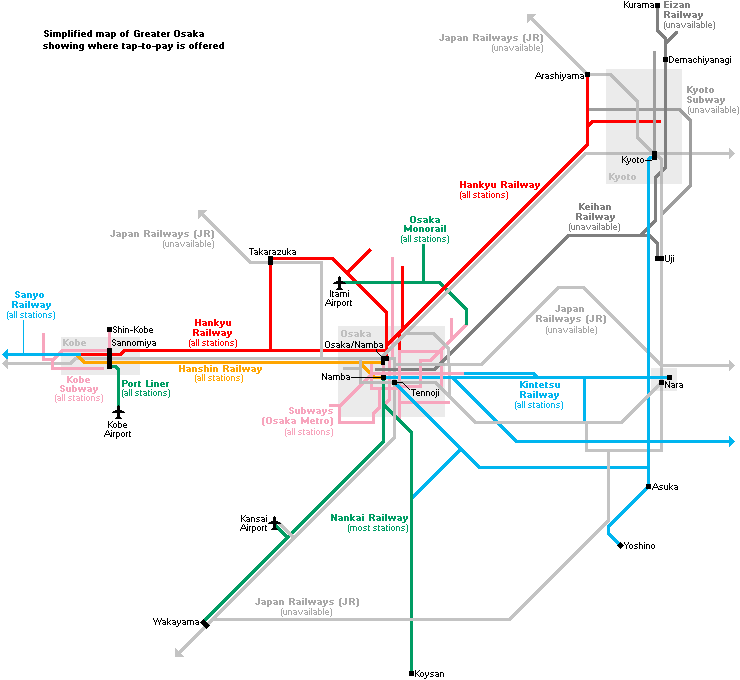
Many railway companies in the Kansai Region accept tap-to-pay at almost all their stations. Prominent exceptions are again JR (which operate many useful train lines in the region), Keihan Railway (one of the companies connecting Osaka with Kyoto) and the subways in Kyoto. Tap-to-pay is not offered on buses in Kyoto either, making credit cards not very useful to get around the city. Automatic 1-day fare capping is offered on the subway in Osaka (Osaka Metro).
- Accepted at all/most stations: Osaka Metro, Hankyu, Hanshin, Nankai, Kintetsu, Kobe Subway, Sanyo
- Not accepted: JR, Keihan, Kyoto subways and buses, Eizan, Randen
Fukuoka
In Fukuoka, tap-to-pay is available on the subways and Nishitetsu Railway (to Dazaifu and other destinations), and here even JR Kyushu is accepting tap-to-pay along many - but not all lines - in the Fukuoka area. Automatic 1-day fare capping is offered on the Fukuoka Subway.
- Accepted at all/most stations: Fukuoka Subway, Nishitetsu
- Accepted at selected stations: JR
Nagoya
In Nagoya, the subway and Kintetsu Railway accept tap-to-pay at all stations, and Meitetsu Railway only at selected stations. But it is not available for the JR trains.
- Accepted at all/most stations: Nagoya Subway Kintetsu
- Accepted at selected stations: Meitetsu
- Not accepted: JR
Hiroshima
Tap-to-pay is not currently available on trains and trams in Hiroshima.
- Not accepted: JR, Hiroden
Sapporo
In Sapporo, the subways can be paid by credit card, but not the JR trains. Automatic 1-day fare capping is offered on the subway in Sapporo.
- Accepted at all/most stations: Sapporo Subway
- Not accepted: JR
How to use tap-to-pay
Credit card readers are attached to ticket gates at railway stations or inside the bus. Note that they are often found only at some of the ticket gates and not at all of them. Look out for gates that are equipped with credit card readers.
Then, simply touch your credit card on the reader for about one second when entering and exiting the station, and your fare will be charged to your card.
Important: Credit cards can be used only if tap-to-pay is available at both your departure and arrival stations, so if in doubt, confirm in advance that your entire journey is covered. Common pitfalls include railway companies that offer tap-to-pay only at selected stations rather than across their entire network, as well as through-services where trains run onto tracks of another company that may not support tap-to-pay.
Which cards work?
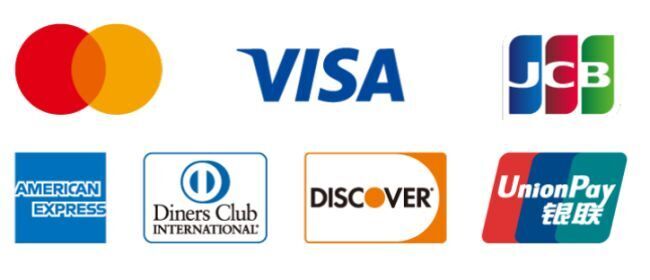
Credit, debit and prepaid cards with the contactless payment symbol  can be used. The major brands, including Mastercard, Visa, JCB, American Express, Diners, Discover and Union Pay are accepted. Alternatively, you can use your smartphone to tap to pay by using a credit card through Google Pay or Apple Pay.
Can multiple people use a single card?
No, one card per person must be used, and only the authorized cardholder is supposed to be using the card. Most companies do not offer tap-to-pay for child fares.
How can I see a record of my fare payments
The Q-move website allows credit card users to see a list of their rides and fares paid.
Are there any discounts?
Automatic 1-day fare capping is offered to credit card users on the subways of Osaka, Fukuoka, Yokohama and Sapporo. It means that if you use subways beyond a certain sum on a single day - usually the cost of a 1-day pass - then you won't be charged more than that amount. This effectively turns your credit card into a 1-day pass. Nothing needs to be set up to profit from such discounts, but make sure to use the same credit card at all times, e.g. don't switch between your physical card and your smartphone even when using the same card.
What happens if tap-to-pay is not available at the arrival station?
You won't be able to exit through the automatic ticket gates and will need to go to a staffed gate to settle your fare. This can be relatively straightforward if the railway company can access your tap-in data. However, if it cannot - typically when you cross into a different company that does not support tap-to-pay - you will have to pay for the portion traveled on that latter company, while the earlier part of your journey remains recorded on your card as an incomplete trip and may incur a default charge higher than the actual fare. To avoid this, make sure in advance that tap-to-pay is available at both your departure and arrival stations.
Can it be used in combination with fare adjustment machines?
No, tap-to-pay works only when you use your credit card both at the departure and arrival stations. If tap-to-pay is not accepted at your arrival station, it is not possible to use a fare adjustment machine to pay for your train journey. Therefore, it is important to make sure that tap-to-pay is accepted also at your destination station.
Can it be used in combination with IC cards, paper tickets or commuter passes?
No, tap-to-pay can be used only if you use the same credit card for the entire trip at both the departure and arrival stations. It cannot be combined with IC cards, commuter passes or other types of tickets to pay for part of a trip.
What about trains that run across company borders?
There are several train lines, especially in Tokyo and Osaka, on which trains provide through-service into a line of a different company. For example some trains on the Asakusa Subway Line in Tokyo run into the network of Keikyu Railway. Caution is necessary when using such trains, because you can use credit cards only for journeys that accept tap-to-pay at both the departure and arrival stations. If both companies offer tap-to-pay, it is good to use, but if one of them does not, you cannot use credit cards.
Can it be used at transfer gates and for transfer discounts in Tokyo?
Transfers are possible between companies that both support tap-to-pay, and applicable transfer discounts are honored. For example, this works between Tokyo Metro and Toei, but not between Odakyu and JR, as JR does not accept tap-to-pay. Out-of-gate transfers - which require you to exit and re-enter the gates but are still charged as a single journey - are also supported within the Tokyo subway system if completed within 60 minutes.
Questions? Ask in our forum.